Absinthe Authors Assemble!
When shall we three meet again: how about 3 pm this Thursday?

Dear word explorer,
The sun is blazing upon the West of Ireland, and half my house is shrouded in funereal shadow for much of the day to keep temperatures at a liveable range. It reminds me of many vampire films in which the undead hide behind security screens, wait beside windows pasted over with newspapers, or sleep deep in vaults to avoid disintegration by solar rays.
Death by the sun has been a trope in vampire cinema since the iconic moment in German Expressionist film, Nosferatu (1922), when Count Orlok (Max Schreck) is destroyed when he loses track of time while feeding upon his victim, Ellen Hutter (Greta Schröder). Hutter sacrifices herself to destroy the fiend, and liberate her people from his predation.
Since then it’s crept into vampire lore as an integral fact, but there was no such severe prohibition in Dracula (1897) by Bram Stoker, the book upon which Nosferatu is based.
In the novel, the vampire expert, Van Helsing, outlines —in stilted English—some of Dracula’s powers and limitations:
He can transform himself to wolf, as we gather from the ship arrival in Whitby, when he tear open the dog; he can be as bat, as Madam Mina saw him on the window at Whitby, and as friend John saw him fly from this so near house, and as my friend Quincey saw him at the window of Miss Lucy. He can come in mist which he create—that noble ship’s captain proved him of this; but, from what we know, the distance he can make this mist is limited, and it can only be round himself. He come on moonlight rays as elemental dust—as again Jonathan saw those sisters in the castle of Dracula. He become so small—we ourselves saw Miss Lucy, ere she was at peace, slip through a hairbreadth space at the tomb door. He can, when once he find his way, come out from anything or into anything, no matter how close it be bound or even fused up with fire—solder you call it. He can see in the dark—no small power this, in a world which is one half shut from the light. Ah, but hear me through. He can do all these things, yet he is not free. Nay; he is even more prisoner than the slave of the galley, than the madman in his cell. He cannot go where he lists; he who is not of nature has yet to obey some of nature’s laws—why we know not. He may not enter anywhere at the first, unless there be some one of the household who bid him to come; though afterwards he can come as he please. His power ceases, as does that of all evil things, at the coming of the day. Only at certain times can he have limited freedom. If he be not at the place whither he is bound, he can only change himself at noon or at exact sunrise or sunset. These things are we told, and in this record of ours we have proof by inference. Thus, whereas he can do as he will within his limit, when he have his earth-home, his coffin-home, his hell-home, the place unhallowed, as we saw when he went to the grave of the suicide at Whitby; still at other time he can only change when the time come. It is said, too, that he can only pass running water at the slack or the flood of the tide. Then there are things which so afflict him that he has no power, as the garlic that we know of; and as for things sacred, as this symbol, my crucifix, that was amongst us even now when we resolve, to them he is nothing, but in their presence he take his place far off and silent with respect. There are others, too, which I shall tell you of, lest in our seeking we may need them. The branch of wild rose on his coffin keep him that he move not from it; a sacred bullet fired into the coffin kill him so that he be true dead; and as for the stake through him, we know already of its peace; or the cut-off head that giveth rest. We have seen it with our eyes.
Jonathan Harker spots a reinvigorated Dracula strolling along Piccadilly on a hot autumn day, and the young man is incapacitated with terror at the sight of his former blood-sucking captor at ease and hunting his next victim in the centre of the English empire in daylight. It’s simpler to dismiss nightmarish fevers from an enforced sojourn in the faraway Carpathian Mountains, but it’s much harder when the monster is accepted by everyday people on the streets of a modern metropolis.
Even though there have been many film vampires immolated by the sun since Nosferatu, the movie that arose in my mind when I was pondering my current half-life was Near Dark (1987), directed by Kathryn Bigelow, and co-written with Eric Red. The 1980s saw a re-configuration of vampires on film, for the appeal of the vampire never dies, it merely transforms for the zeitgeist.
Vampires slipped into clubs (The Hunger), suburbs (The Lost Boys, Fright Night), arrived via spaceship (Lifeforce), and proved popular in anime (Vampire Hunter D and Vampire Princess Miyu).
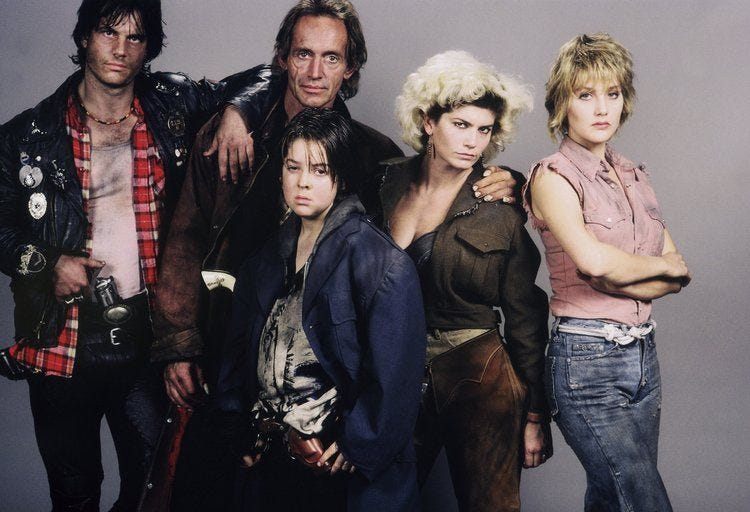
Near Dark has a different vibe, twanging the sensibilities of Western movies where a gang of outlaws threaten decent folk, but shot to a score by Tangerine Dream. Travelling through the bleached wastelands of 1980s Oklahoma, these vampires are a roving band of dissolute punks devoid of the usual trappings of glamour and wealth. The sun is the only hindrance to their murderous sprees.
Local boy Caleb Colton (Adrian Pasdar) falls for the pretty newcomer Mae, only to discover she’s far more capable than she looks. The story is thin, but the characters are memorable and are played by a terrific team of actors. Bigelow delivers strong visuals and set pieces, avoiding too much violence until the bloody dive bar scene. It’s the sun that’s the biggest killer in the film, with vampires bursting into flame under its unforgiving judgement.
You can almost taste the grime and sweat raised from the oppressive heat when the sun is out. It’s a film to watch during the winter, when you hanker for warmer days.
Ireland will endure this hot stretch for at least another week, but the upside is that I’m actually using my summer wardrobe; some years it never fully transfers from storage.
I even wear a hat: but not a Stetson…

As part of my mini-series of conversations around the publication of my novella, House of Wyrd, last Thursday I had a terrific chat with publisher Nicky Crowther about the genesis and development of PS Publishing, an independent press in England.
Early on, Nicky worked as Art Director (and admin) for PSP, which was established by her husband Pete. Over the decades she has become increasingly involved in running the business, ably assisted by a solid team. Across 80 minutes we covered so many topics: the importance of social events such as conventions for meeting fellow authors and selling books, how the business has changed, and the large array of titles that PS Publishing now produces.
It’s hardly a get-rich scheme, so the entire endeavour is fuelled by a love of books! Support your local authors and presses: it’s vital and appreciated.
I’ve added a bonus Wyrd Conversation! At 3 pm on Thursday, the 16th of July I’ll be chatting with authors Helen Grant and Tom Mead, my Absinthe Books fellows!
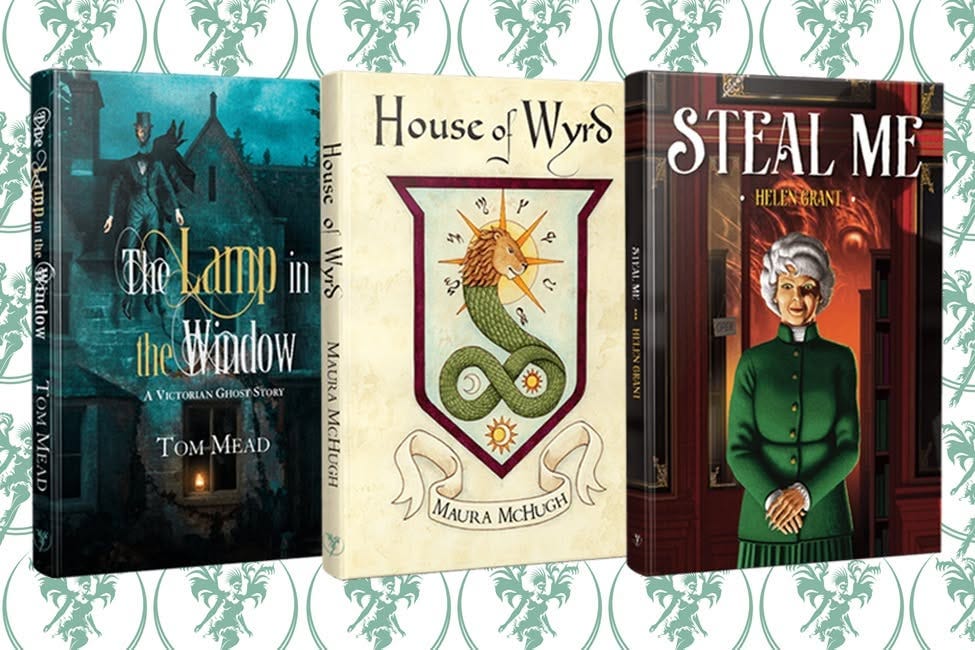
Every year Absinthe Books releases two batches of three novellas, and the initial trio is out this month.
Helen lives in Perthshire, Scotland and her novella is called Steal Me. Her most recent novel was Jump Cut (2023), and her short story collection Atmospheric Disturbances was published in 2024 by Dublin’s Swan River Press. Joyce Carol Oates has described her as ‘a brilliant chronicler of the uncanny as only those who dwell in places of dripping, graylit beauty can be.’
Tom Mead is a mystery writer and aficionado of Golden Age crime fiction. His novels include Death and the Conjurer, The Murder Wheel, Cabaret Macabre and The House at Devil’s Neck. He also recently published a collection of mystery stories, The Indian Rope Trick (And Other Violent Entertainments). His books have have been nominated for various awards and named books of the year by The Guardian, The Telegraph, Publishers Weekly and CrimeReads.
I’m in good company!
Please drop by on Thursday when we’ll talk about writing, our novellas, and we’ll even do a wee sample reading.
In the meantime: be glad of the shadows!