

signing
pens, ink and a meditative signing

Dear word explorer,
Is your handwriting legible or does it look like the scratchings of a drunken spider dipped in ink? Where you of a generation that learned handwriting in school, both the basic shapes and the fancy cursive ‘joined-up’ handwriting? Perhaps you have a version of dyspraxia which makes the entire process a chore.
I’m a regular journal-writer, and most of my fiction projects begin on the page, so I hand write a great deal. I even correspond via letter with a few pen-pals, although I am behind on that score currently.
A few months ago when reading one of my journals, I ended up squinting at several words to try and understand the scrawl. Some of this is simply the result of rushing. My thoughts are not lackadaisical, and I have a tendency to dash after them with my pen, afraid I will not keep up.
Since September last year I’ve been drawing and painting on a more regular basis. Once you return to a practice after a long absence you are immediately struck by the atrophy of ability. Most people are familiar with the adage, ‘use it or lose it’, but Leonard da Vinci had a more evocative description:
Iron rusts from disuse; stagnant water loses its purity and in cold weather becomes frozen; even so does inaction sap the vigor of the mind.1
But there is also a depreciation that occurs through a lack of care. I decided to begin remediation by writing letter drills every day. I fished out a bullet journal from my stack, and began to write each letter in a line across the page.
Wow, did my brain buck at this! The neural pathways for writing have been set since childhood, and while some of them may have been tweaked along the way, my brain has been super satisfied with the craftsmanship of those skill corridors. It likes nothing better than familiar, smooth connections that don’t require surplus energy to engage. I imagined a supervisor in a hard hat, hands behind its back, whistling contently as it passed the old routes. ‘They knew how to build back then, when everything was fresh and pliable.’
The contractor’s job had been certified and it had moved on decades ago to newer, more pressing tasks such as digging up the doom-scrolling habit (a budget-busting project).
Suddenly, I was walking along those ancient pathways, kicking at their brickwork with a vexed expression, and provoking consternation by my neural-supervisor. This was objectively unnecessary!
There’s an odd sensation that occurs when you attempt to rejig such an assimilated ability. Occasionally you have weird tics and your pen makes quirky movements. You question your ability to write at all. You notice how an r, u and a v can look identical if you don’t focus on refinement. Sometimes you get into a rhythm and you forget when to end an m and it gains an extra arch (also known as a ‘hump’).
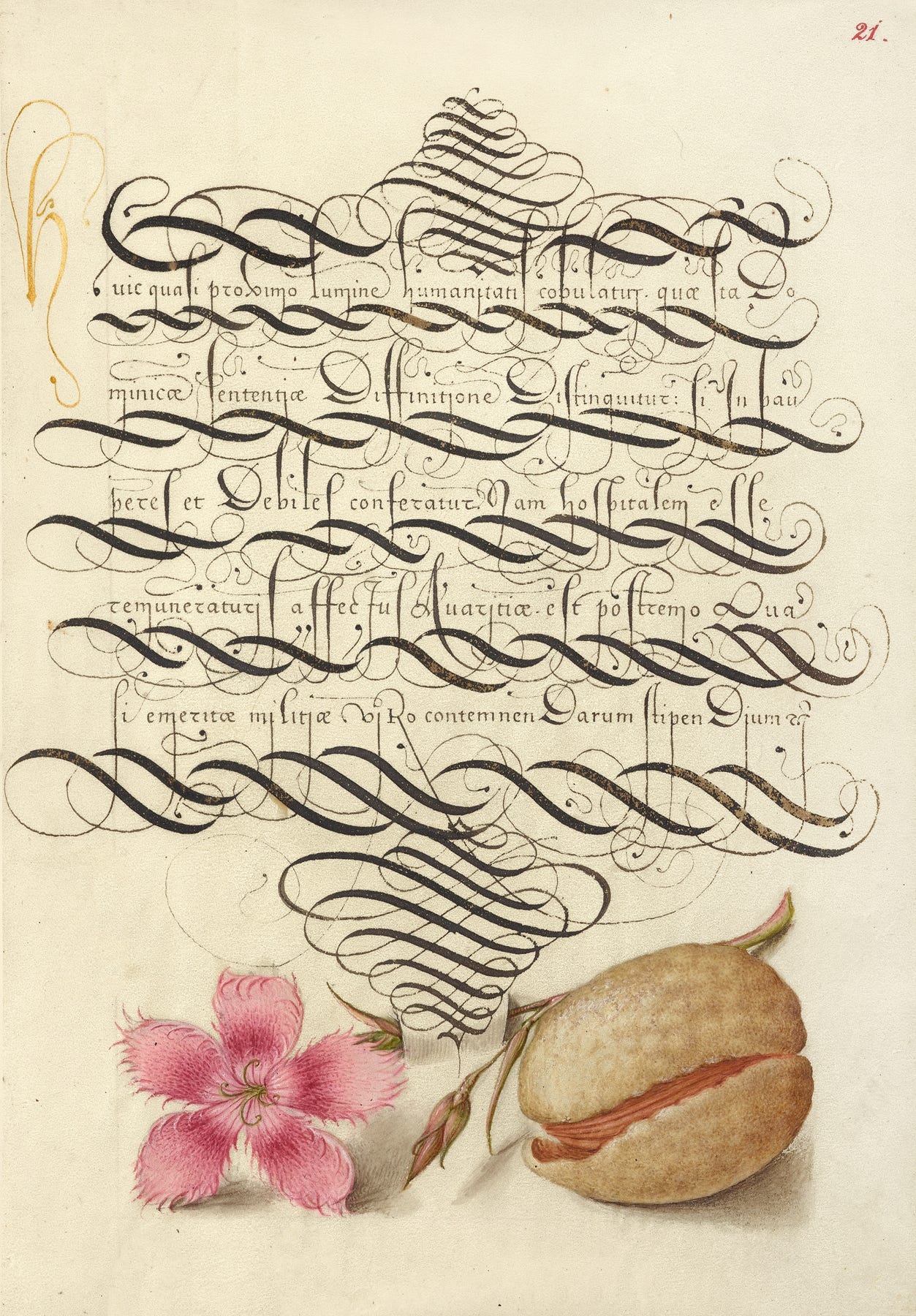
I wasn’t attempting to stretch into calligraphy… yet. When I studied Art in secondary school I specialised in calligraphy for my Leaving Cert, and it is the Imperatrix of handwriting. The neural tracks for those precise movements had been repurposed long ago, probably during the white heat of crisis when I learned to drive and all resources were gobbled to create a bicameral geography.
The fastest way to improve is simple: slow down and repeat. That’s all it takes. In the beginning I fell into my typical impatient move of ‘just get it done’. After a few days I recognised my error and decided to focus on the pleasure of the well-formed o and the lovely l loop.
After a week I saw improvement. That neural-supervisor had complained and protested but eventually it recalled the contractor, who was astonished at this revision— it was all rather fundamental; and the contractor loved it.
This is the nuts and bolts of being human: engaging in making. Even something as simple as a line of text.
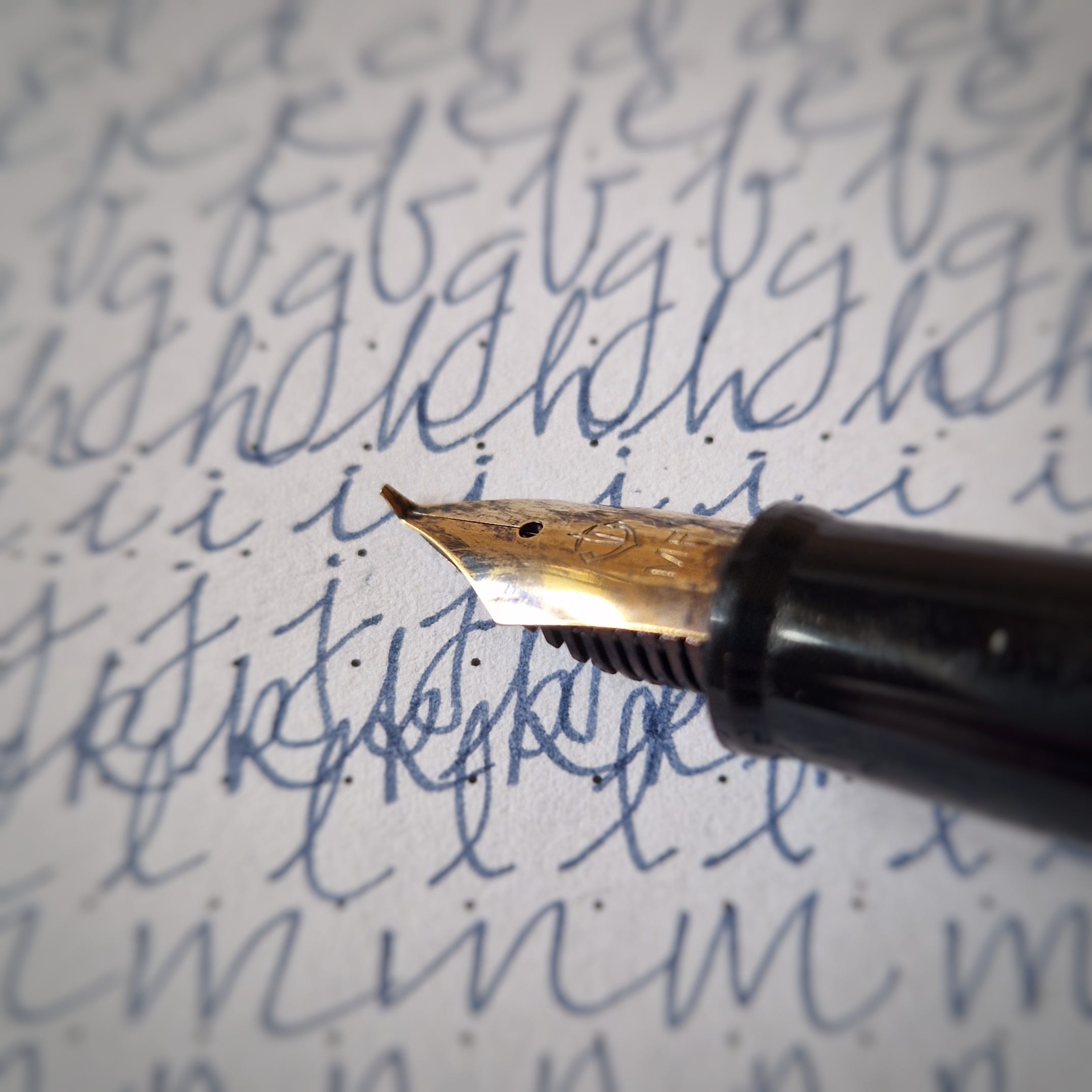
Before I embarked upon this handwriting revision I stumbled upon the Sailor Fude de Mannen fountain pen with a 55°angle nib2, thanks to my love affair with watercolours. 3
Galway-based Watercolourist and Urban Sketcher expert, Róisín Curé, is a fan of these inexpensive Japanese fountain pens (you can get them in a variety of angled nibs). I know Róisín from the Irish comic book scene4, and I had followed her work over the years, especially her YouTube channel which took off in the post-Covid world.
Through Róisín I discovered both the Fude pen and the German Ink company, De Atramentis, which produces a colourful range of Document Inks. What is a Document Ink? It’s lightfast, waterproof, acid-free, and fast drying, so it is an archival standard ink that’s designed to prevent document fraud (it resists chemical alteration, washing, and unauthorised duplication).
It might be surprising that I’ve avoided sinking into the fountain pen and ink obsession… many, many of my writer friends are deep in that passion pit. Although I’ve become a fan of the Fude fountain pen and this brand of ink, I have not allowed my interest to slip into the splurge territory. I simply do not have the funds to become a fountain pen fancier!
My main appreciation for the Fude is the ability to create three different lines of thickness from the one nib.
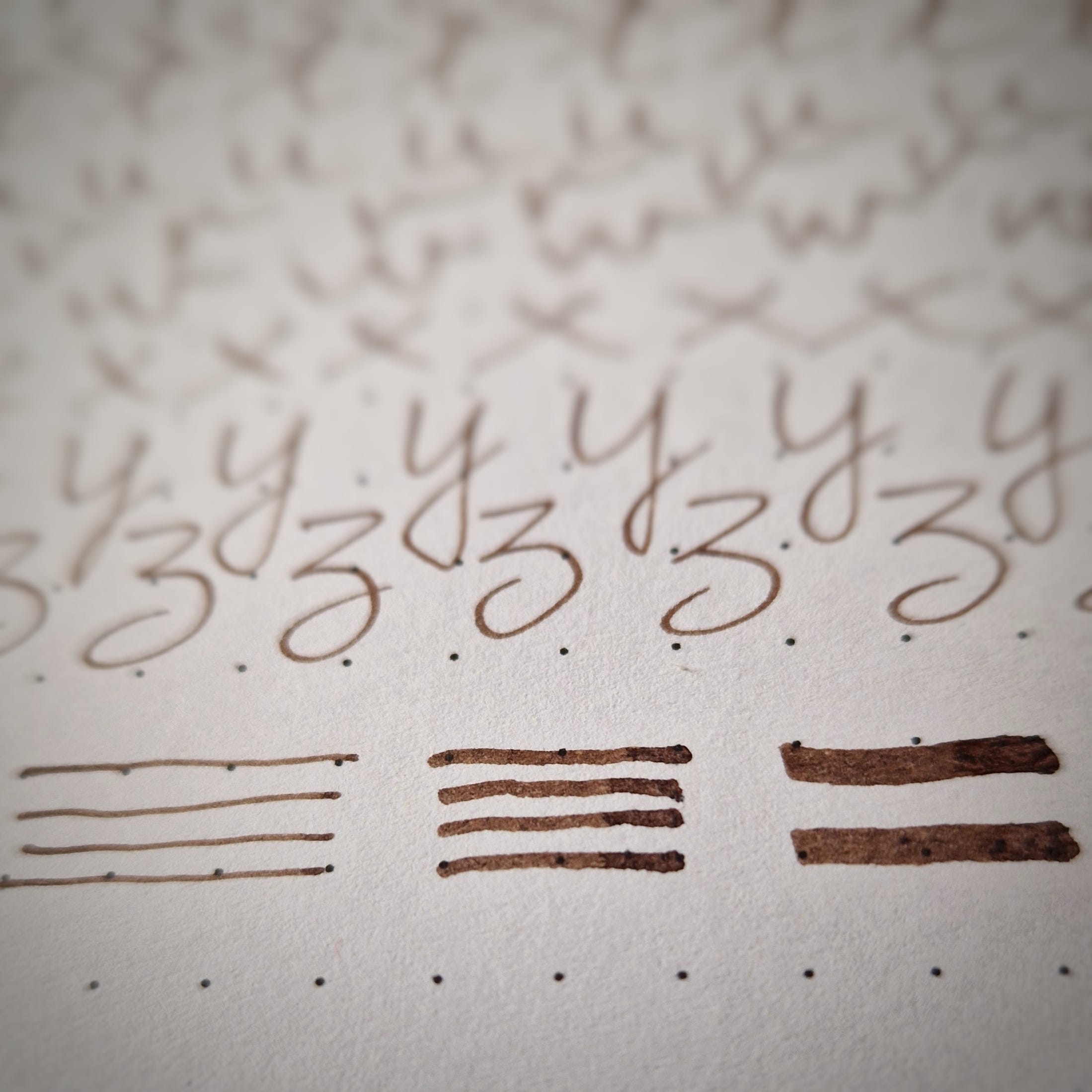
To get that thin line I write with the fountain pen upside down, and yet it’s a smooth experience. The versatility of line from one fountain pen is extremely handy. It’s particularly useful if you want to draw en plein air (‘in the open air’). If you use Document Ink for outlines you can paint watercolours over it with no fear of smudging.
Now I look forward to my daily writing drills. I’ve also added in drawing basic shapes (circles, hatching, squares, spirals) to regain finer motor control for line work, and I’m slowly branching into foreign alphabets.
There is a meditative quality to this practice — it encourages a loose attentiveness at its best moments. I’m hardly inventing anything new! In Japanese Zen, ensō (“circular form”) is a circle painted with one brushstroke and using a single breath. Finding that artful, perfectly imperfect circle is the result of years of practice and millions of attempts. The neural pathways do not become lazy. They are encouraged and kept active with kind repetition and care.
In the moment of creation the painter, the brush, and the paper become one.
I’m not yet at this peak!
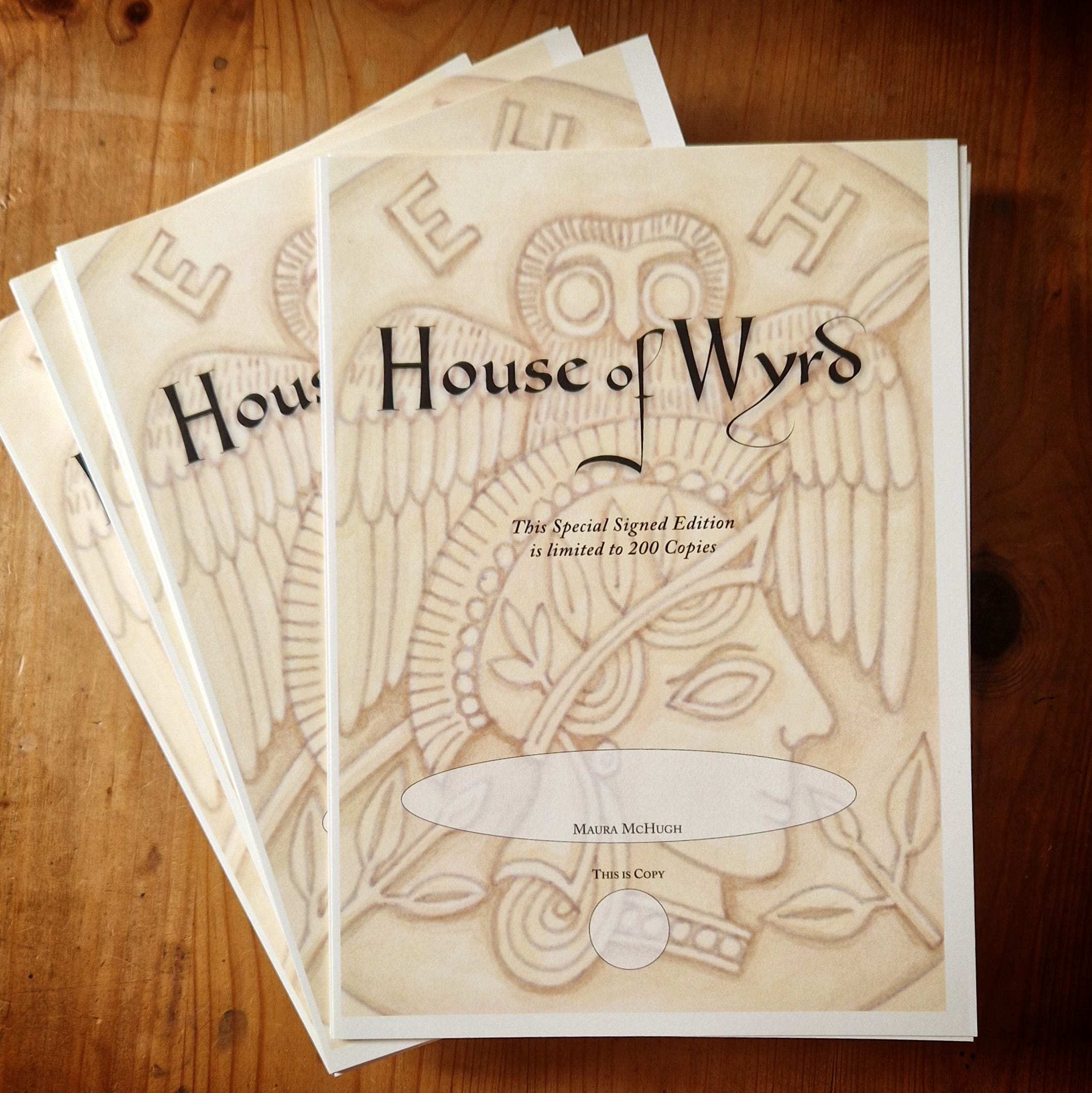
On Monday I received a package from PS Publishing with the signing sheets for the limited edition hardback of my forthcoming novella, House of Wyrd (available for pre-order).
The artwork is part of the endpapers that my cover artist, Lisa Laughy, designed for the volume. The main character of the story is called Pallas — after Pallas Athena — which explains the the iconography in this image. What a delight to open the box and to see Lisa’s work given an extra boost.
I’ve signed signing sheets for books before, but it’s the first time since I’ve been practising writing in a more conscious fashion.
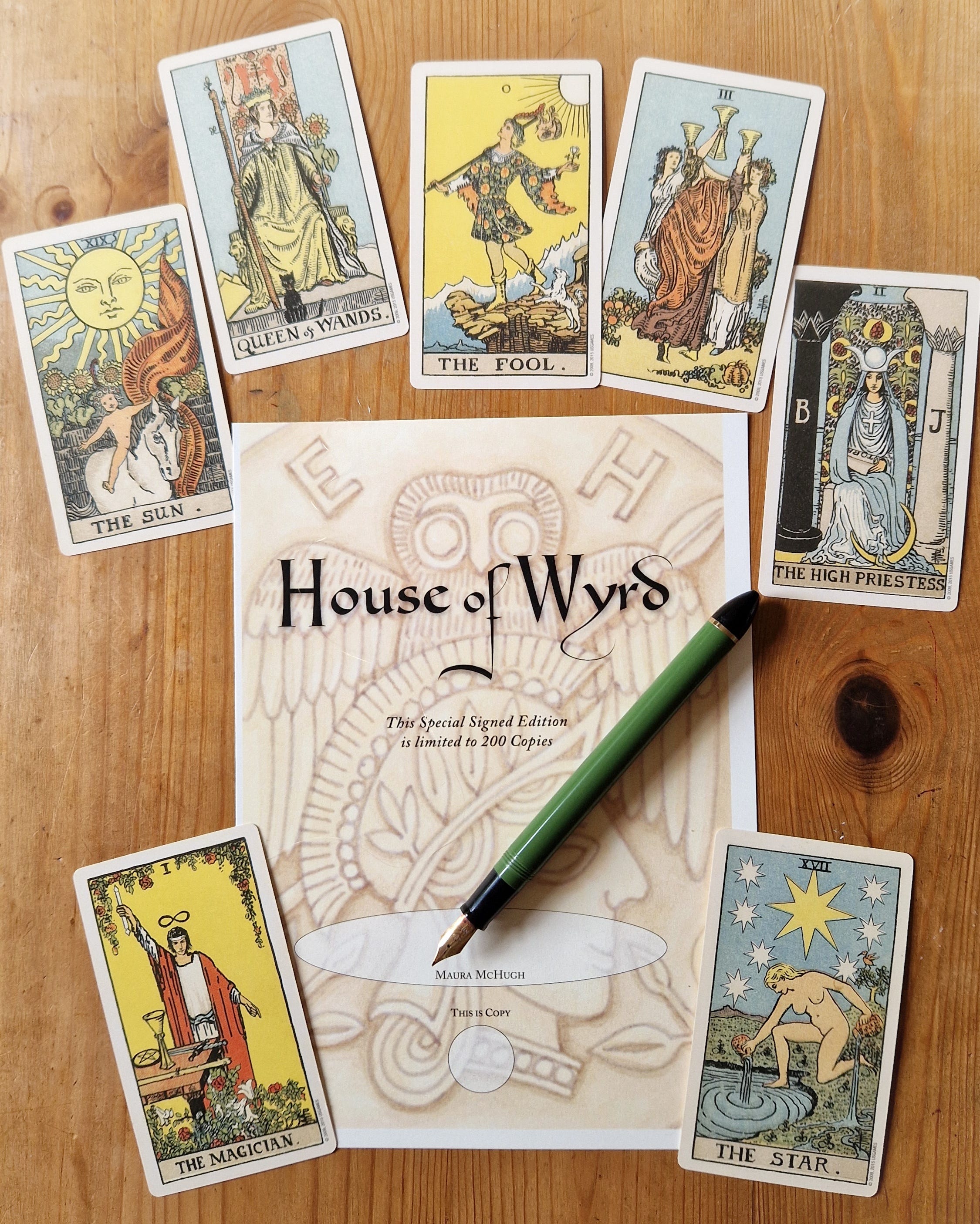
The Tarot feature strongly in this book, so I picked out a selection of pals for the photo op to mark the moment. Then I loaded up the Sepia Brown in my fountain pen and began signing my name.
The house was quiet, and through the open window the birds chirped and rustled across branches. I wrote my name and considered the people who would buy this book, open the cover and see my signature. I thought about the team who have invested so much effort to create this volume.
As I wrote my name over and over, I thanked all future readers, and I hoped some magic of this making would be imbued in the book.
I thought of the entire process: from the first nebulous idea, to short pitch, then the words on the page, as well as the edit, the art, the layout, the paper printing, the binding, and the final rollout of the copies (hardback and paperback). All these elements are drawn together to launch an imagined world to an audience.
As my pen looped my name and I moved paper from one pile to another, I remained in a period of meditative appreciation.
What a gift! Thank you!
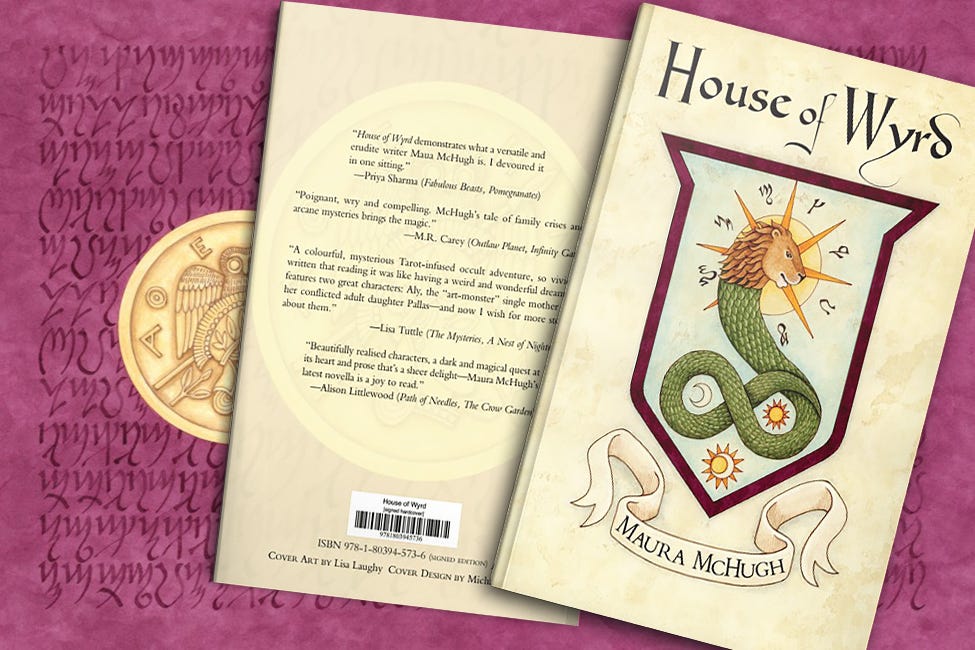
Here’s a brief blurb about the book:
Aly Wyrd, famous art provocateur and magician, is missing on the eve of the opening of her visionary project, the Path of Illumination. It falls to her estranged daughter, Pallas Trismegistus Morrigan Aylward, to navigate through dream, memory and arcane mystery to revisit her history
with her mother in ’80s London and ’90s Ireland until Pallas catches up with present-day revelation by walking the road to enlightenment designed by her mother.
Pre-order the special edition here!
From his notebooks, as transcribed on Wikiquotes.
You need to buy a converter for the fountain pen separately so it is refillable, otherwise you’ll have to use an ink cartridge.
I am not receiving compensation for any plug — I’m sharing what I like.
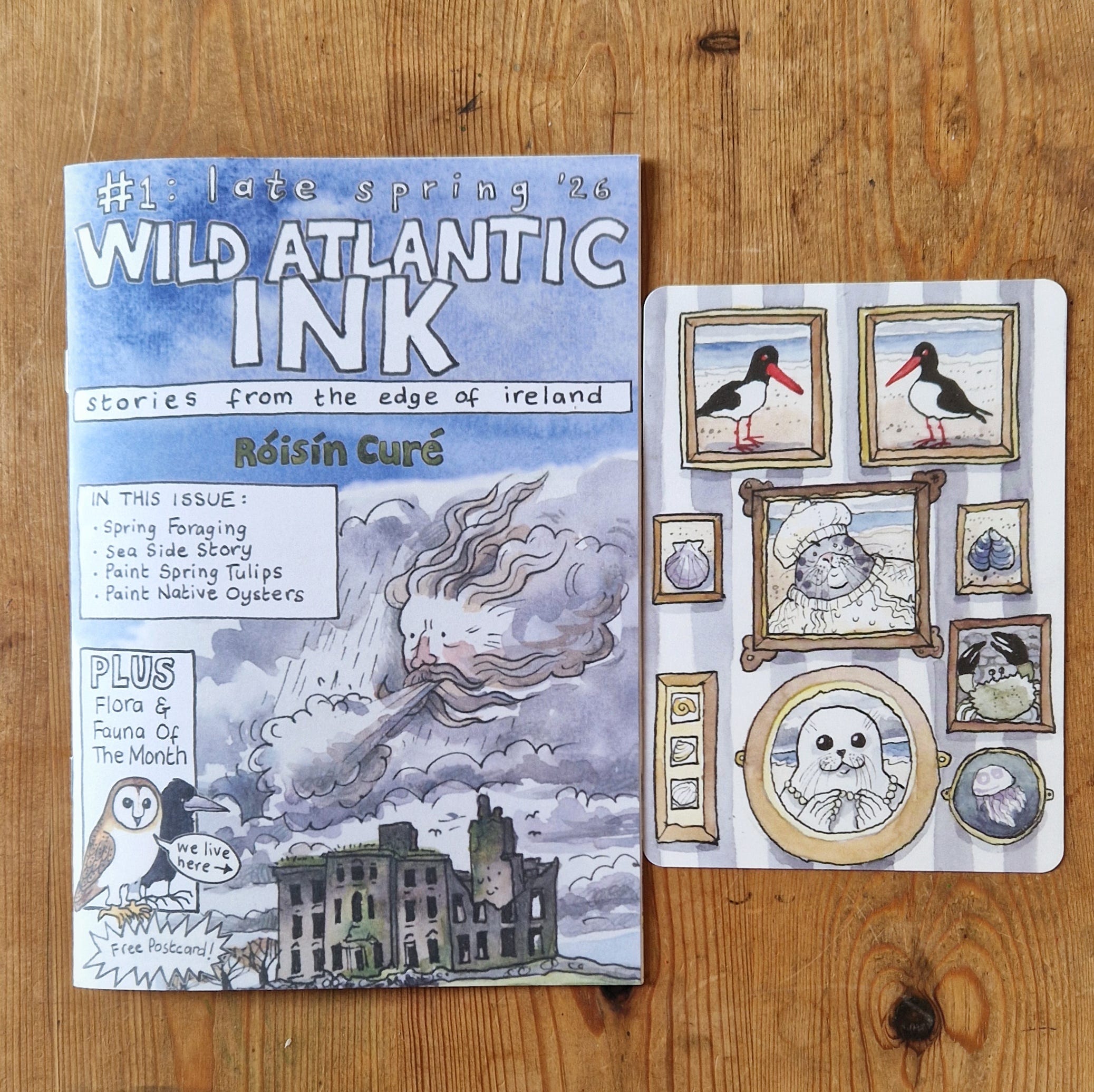
Róisín has just published a beautiful, small comic called Wild Atlantic Ink, a charming selection of thoughts, stories, and art tips!
This sounds like a practice I ought to engage in. I do loads on hand writing, but it's a scrawl only legible to me as well as inconsistent. I never could write neatly (dyspraxia), so I gave up at some point and just wrote anyway. It's served me well to let go of expevattions, but to see it as a meditative practice might change things. And what a lovely way to bless your book. 🤓
Fab! Looking forward to getting my copy of your book, with your meditative signature!