

Super Sun
It keeps sending us fireworks


Dear skywatching reader,
Did any of you see the magnificent auroras last Friday? It was an incredible night and the pictures and videos from across the Northern Hemisphere were glorious. The sun’s charged particles from its massive coronal mass ejections (CMEs), carried by the solar wind, collided with the Earth’s magnetosphere to create these stunning light shows as far south as Puerto Rico — apparently the last time this occurred was back in 1921.
If you look into that event it is often referred to as the ‘New York Railroad Super Storm’, which also occurred in May 1921: from the 13th - 15th, funny enough! The biggest geomagnetic storm of the 20th Century lit up the skies and the telegraph wires for three days.
There’s a great description of the havoc the storm caused across the globe in this spaceweather.com article by Dr Tony Philips.
And then the fires began. Around 02:00 GMT on May 15th, a telegraph exchange in Sweden burst into flames. About an hour later, the same thing happened across the Atlantic in the village of Brewster, New York. Flames engulfed the switch-board at the Brewster station of the Central New England Railroad and quickly spread to destroy the whole building. That fire, along with another one about the same time in a railroad control tower near New York City’s Grand Central Station, is why the event is sometimes referred to as the “New York Railroad Superstorm.”
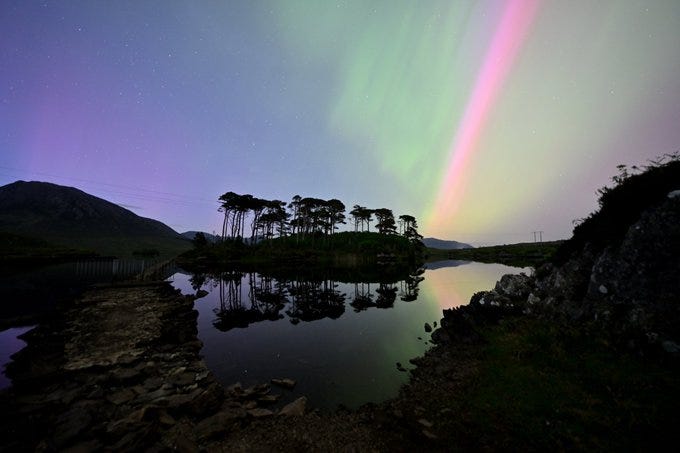
Thus far we have not seen anything as damaging during the current solar hi-jinks. The aggressive sunspot AR3664 is slowly rotating out of view, so any further sun shots will probably miss the Earth, however…
This afternoon, just as it was at its last window of opportunity, AR3664 blasted out a massive X8.7 flare. In context, the most powerful flare recorded in the 21st century was on 4 November, 2003, and was estimated to be at least an X28 — the associated CME travelled at about 2300 kilometres per second (8.2 million km/h). Thankfully, it happened while the combustive sunspot was not aimed at Earth.
The likelihood is that any CME created by this current flare will miss our planet, but thanks to the Parker Spiral, we may have some effects. Spaceweather.com explains it as ‘a magnetic superhighway’, and this is because AR3665 is passing over a section of the sun that is magnetically connected to Earth.
This effect is named after Dr Eugene Parker (June 10, 1927 – March 15, 2022), who first proposed the mathematics for the solar wind, and coined the term itself. NASA’s Solar Parker Probe — which I’ve mentioned in previous newsletters —was also named after him.
Last weekend is was so uplifting to view the images and videos that scientists and ordinary people were submitting of their aurora viewings. I love to see people in awe of the gorgeous design of our planet, which supports and protects us.
We’re lucky that Earth’s magnetic field works as a buffer against most of these ferocious ejections — Mars is not so fortunate!
The Red Planet is currently at its perihelion — the closest point in its orbit to the sun — and does not have the luxury of a magnetic field. This is going to be a serious issue to consider in the preparations for human missions to Mars (among many others factors, of course!).
NASA's MAVEN (Mars Atmosphere and Volatile EvolutioN) is currently in orbit above Mars, and in conjunction with the Curiosity rover trundling over the surface, they will study the effect of solar particles from above and below. So this current solar hyperactivity is of strong interest to scientists, such as Shannon Curry, the principal investigator for MAVEN. She said:
"I'd actually love to see the 'big one' at Mars this year — a large event that we can study to understand solar radiation better before astronauts go to Mars."
Be careful what you wish for!
From the sun, back to earth, and our everyday reality.
I wanted to mention an app I’ve been using lately, which might be of interest to readers. It’s called Yuka, and it was introduced to me by a friend. It’s an app that allows you to scan products (foods, cosmetics, etc.) and easily view the ingredients. It also categorises these items, which often have incomprehensible chemical designations, into various risk levels from ‘hazardous’ to ‘low-risk’.
All the impacts of the ingredients are totted up and result in a ‘Bad’ all the way to ‘Excellent’ rating out of 100. Unfortunately, I have a number of sensitivities, and over the past decade or so I’ve had to become more mindful of what I use on my skin or eat. Oh, the downsides of the fair Irish skin! As a result I’ve had to do a lot of research in this area and I would consider myself moderately educated on the subject of nutrition, and also pretty savvy about the best products to use or consume. Yet, I often struggle with the tiny print and the way companies change the names of some of the ingredients.
Scanning foodstuffs with Yuka was both a reassuring and alarming exercise. You’re not going to get a good rating for a cookie or a cake, after all, we know it’s an indulgence, and hopefully we’re not going to feast on it constantly, but when you notice the ‘hazardous’ ingredients your appetite dwindles. Butter and Halloumi won’t rate very highly on the app for example, but it’s a product made from a few simple ingredients, so that’s acceptable. It will also suggest alternatives with higher ratings based on the products other users have scanned.

It’s when you start scanning cosmetics, shampoo, skincare products, and even bubble bath that everything starts to look bleak. Companies that I thought had a decent rep disappointed me several times, while the occasional big brand or even own label products could have acceptable ratings.
For instance, phenoxyethanol is present in so many skin/bath/shower products, partly because its a commonly used perfume fixer and a preservative. It also can cause allergenic responses, which is why in the EU it is ‘is authorized as a preservative in cosmetic formulations at a maximum concentration of 1.0%’ (but is recommended at .4% for children under three years old).’
I’m not a purist. We live in this world and there are a lot of complicated decisions we must make. But if every product you are using has something like phenoxyethanol in it then you are far exceeding the recommended dose. That’s where something like Yuka becomes super useful.
In our household we regularly consume both canned coconut milk for making sauces and coconut milk for use with cereal and drinks. It’s been a bit of a revelation to sift through the brands and figure out which ones were better than others — and it wasn’t always based on price.
Who are the people behind this app? It was conceived during a Hakathon in 2016 by Benoît Martin, a French financier, with the help of his younger brother, François, a computer engineer. Later, their consultant friend Julie Chapon joined them and they founded the company in 2016. In France and many European countries this app is now very well known, and since 2022 it’s been taking off in the USA. This year the trio moved to New York to cement Yuka within the American market.
The company claims to be independent. It’s ad-free, and does not process or sell user data. It says it has no outside influence from market brands. The majority of its revenue comes from the ‘premium’ version of the app — which I paid for. For a simple €15 (in fact, you can pay less) I got the ability to search for products via the name rather than by barcode, and it allowed me to select allergens that I don’t want in my products. A very useful feature for those who have known sensitivities.
One aspect I like is that problematic ingredients will have a link on which you can click. The app will then offer you information about them, and a list of sources so you can investigate further if you fancy.
I’m not being sponsored by the app, and I can’t guarantee that their claims are correct. All I can say is that I’ve found it handy as I’m dealing with a flare of an auto-immune condition, and this is helping me navigate certain product choices.
Equally, I understand that people could get obsessive and place too much faith in its ‘authority’. I suggest seeing it as a helpful guide.
Over the decades I’ve watched a lot of companies come and go, and clearly this app will pose a problem for many food and cosmetic markets. I’m guessing there will be hit pieces about its weaknesses and many attempts to buy them off. It will be interesting to see how they develop and expand.
I tend to be cynical in this department, but at the moment they seem offer a accessible service with no sneaky extras. We shall see…
Let me know if you use it, or try it out, and what you think of it.
Until next week… don’t forget to look up from your phone, and keep watching the skies!

Thanks for the rec on Yuka. I'm curious and to be honest I'm always telling people about products and how bad they are but now I have more proof of it! Especially when it comes to sun care. 🌞 I don't drink coconut milk but I use it for cooking spray... I usually drink almond milk. I am somewhat lactose intolerant. We age... as you said. This was a very thorough and enlightening post. I like how you tied in that we have to make complicated decisions... I feel you on that one on so many levels right now.
Again, love your writing and style. I always look forward to your posts.