

Bluebell season
fearsome beauty rings violet bells, but do not tread in forbidden dells

Dear word explorer,
The Spring explosion continues in Ireland, thanks to a burst of rare sunshine.
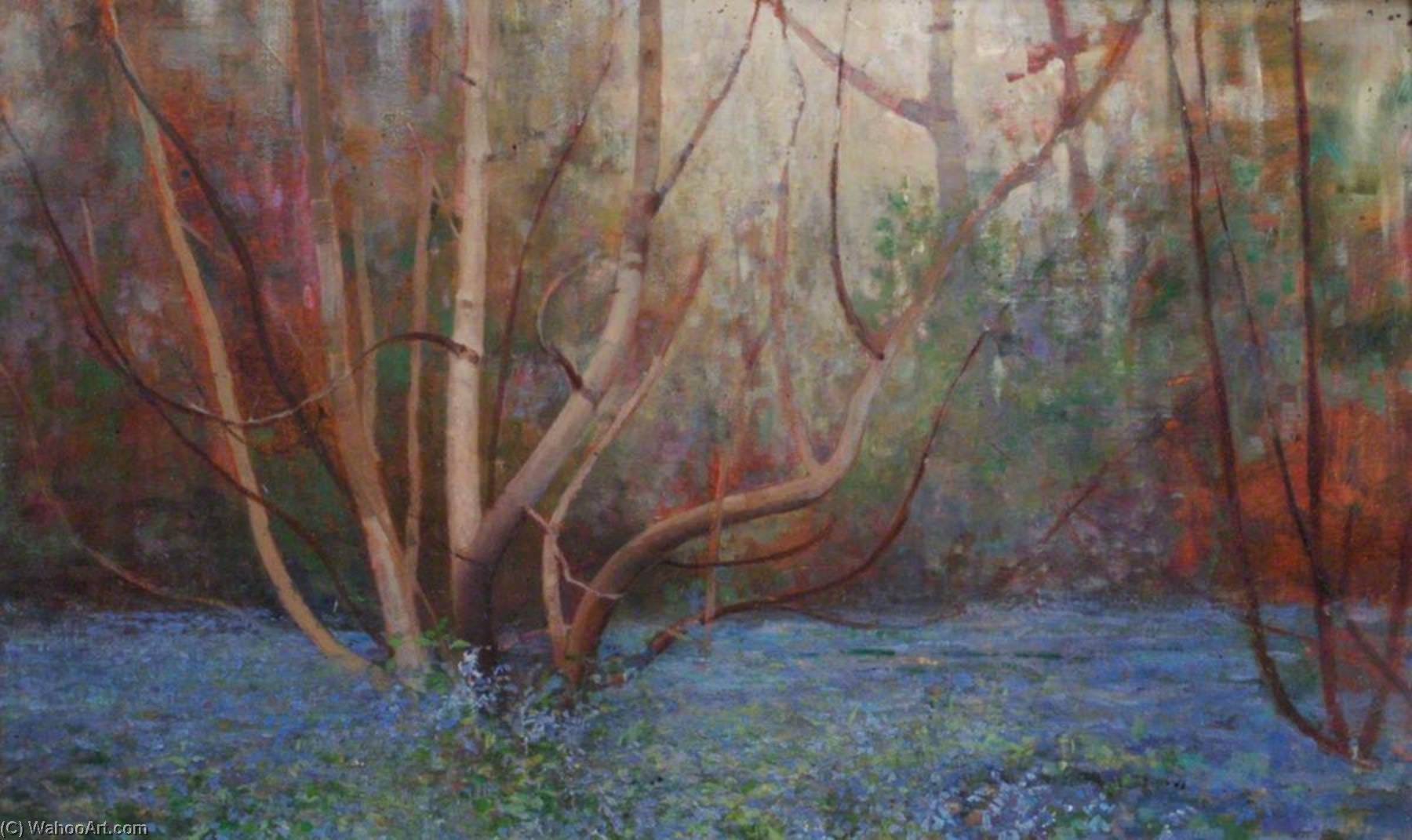
Recently I went hunting bluebells. For me, they are the archetypal April flower, and since it’s my birthday month, I associate it with longer days, warmer temperatures and good cheer. For me, April truly begins when I spot my first bluebell.
The best experience occurs when wandering deep in the woods, and you spy a violet haze lingering upon the sun-splashed thickets. It’s a breath-catching sense of impinging upon a glorious but forbidden territory.
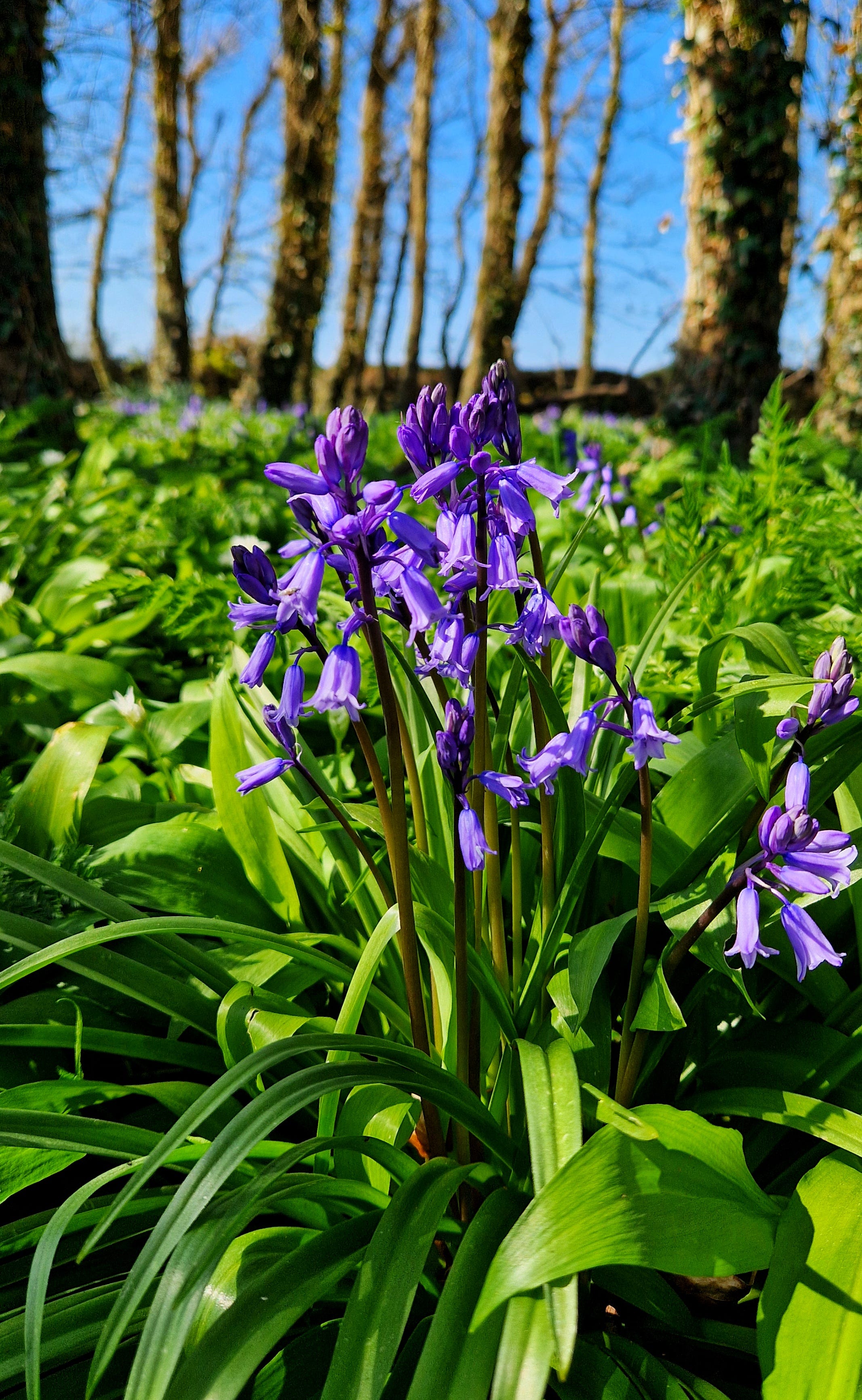
The bluebell’s official name is Hyacinthoides non-scripta, and it’s native to Ireland and the UK. The non-scripta means unlettered, and it was meant to differentiate the bluebell from the Hyacinth.
I travelled to a local area which has an open, managed copse where bluebells bloom every year. I carefully navigated the space, taking photographs of the bluebells. Two women were walking among the clumps picking several of the flowers, while commenting on their beauty and delicate fragrance (although the wild garlic was out-preforming them).
Immediately, my internal voice piped up, Oi, that’s illegal! This is one of my difficult traits, a bit of a rules-lawyer and a protective attitude towards natural areas, which can get me in trouble sometimes. The voice shifted gear into full-on internal diatribe, lamenting their selfishness. To divert my thoughts I turned away from the duo, and wandered to a different patch, but I noticed they were not trampling the area and only plucked a few beauties.
I told myself: Maura, they are being selective and it is not your place to judge. These bulbs are deeply rooted. You’ve seen them bloom every year for as long as you’ve lived in this area. These bluebells may flower annually long after you’re dead. In the grand scheme of things their admiration of this space may bring a positive change. Focus on your enjoyment and do not hinder theirs.
I immersed myself anew in capturing the flora glory and soon forgot about the flower pickers.
Today I checked my ‘facts’, and I was wrong.
It is not illegal to pick bluebells in Ireland. In the UK, it’s not illegal either, but only in areas where they are truly wild (not on parks or land owned by other people), and only if they are for personal use — you are not allowed sell them. It is illegal to dig up the bulbs in the UK. While that doesn’t seem to be illegal in Ireland, it’s simply bad behaviour.1
It was a useful reminder that one should not act on a perceived injustice without knowing the whole story. What contribution would I have made by shaming the women (incorrectly), and ruining the pleasant vibe of the mellow afternoon?
It’s better to save my fervour to direct it positively for a genuine cause.
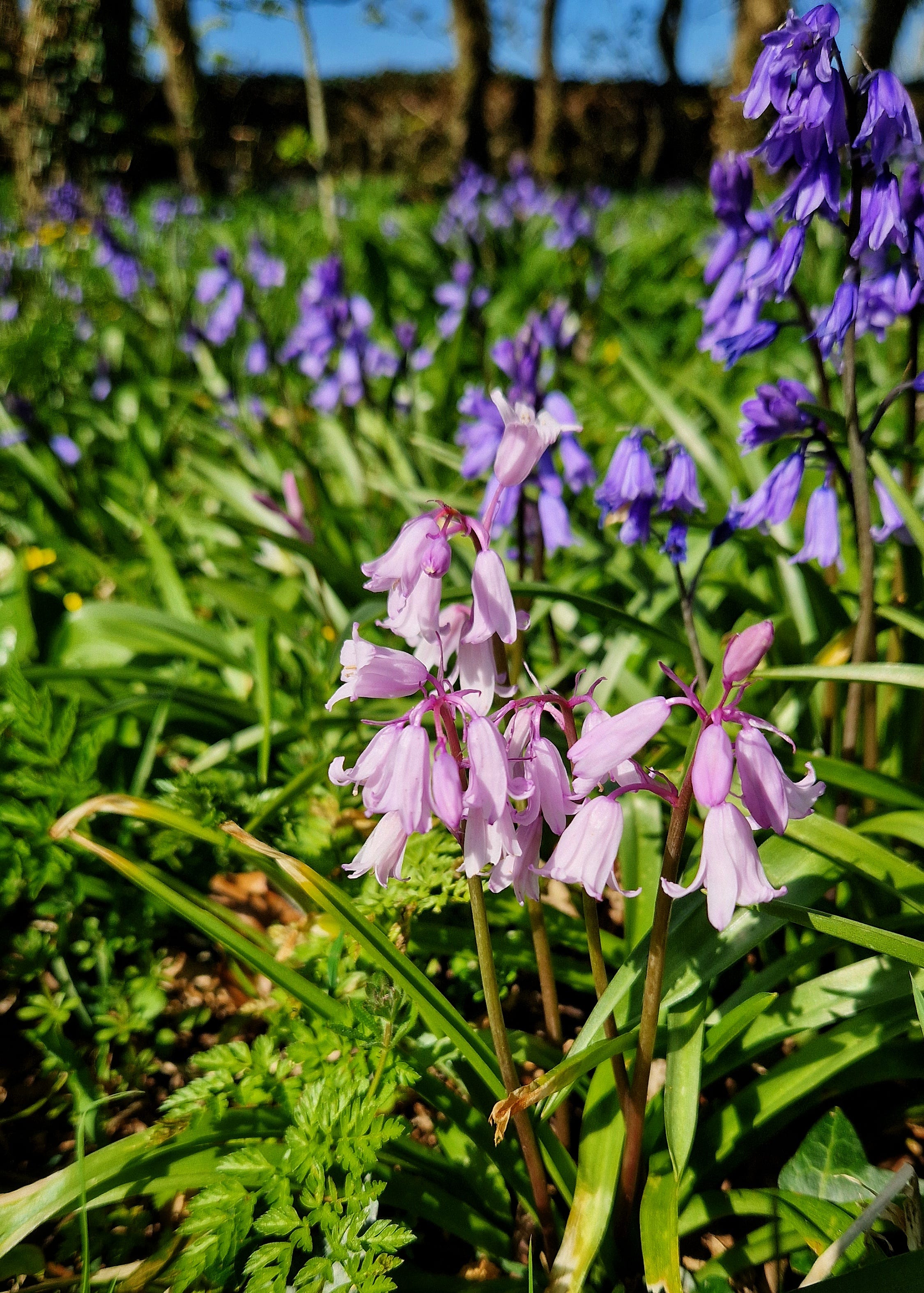
Also, I’m pretty sure this beautiful stretch of bluebells are not the native variety, but the Hyacinthoides hispanica, the Spanish Bluebell, or its hybrid, Hyacinthoides hispanica x non-scripta.
The oldest form of bluebells reside in untampered deciduous woodlands, hedgerows, meadows and perhaps on cliffs. They require humidity and safety from bruising, animal grazing, water-logged earth or deep shade. If they linger in semi-wild areas they are an indicator that the land was once covered in forest. They offer a floral tribute to a vanished presence; a bluebell headstone.
As a result Hyacinthoides non-scripta are threatened by habitat loss, hybridisation and are easily pushed out by the hardier species.
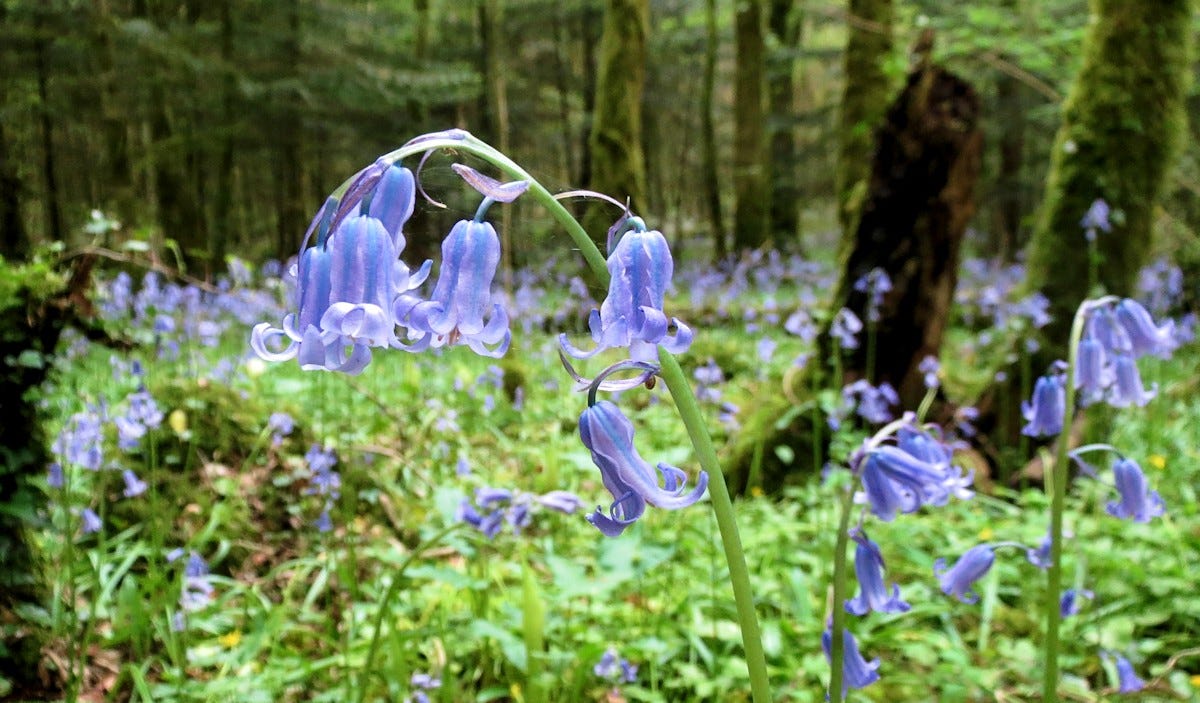
Bluebells are coinnle corra in Irish, which can be translated as ‘tapered or pointed candles’. They’re also known as cloigíní gorma (little blue bells), and they have always been associated with fairies. It was considered dangerous to walk through a bluebell mist, and to hear them ring was a herald of doom. In Ireland, anything associated with fairies was considered unlucky to bring into your home.
Back in the day smart people didn’t even call them fairies, which was considered disrespectful and might bring you to their attention. Rural people might use euphemisms such as ‘The Other Crowd’ or ‘The Gentry’. They were considered dangerous, fickle beings who had their own strange set of rules. They were particularly wrathful against arrogant humans.
The Dúchas Project in Ireland is the digitisation of the National Folklore Collection (NFC) which was created ‘to collect, preserve and disseminate the oral tradition of Ireland.’
One of the most interesting sections of this archive is The Schools’ Collection: ‘740,000 pages (288,000 pages in the pupils’ original exercise books; 451,000 pages in bound volumes) of folklore and local tradition were compiled by pupils from 5,000 primary schools in the Irish Free State between 1937 and 1939.’
It was a terrific initiative and remains a source of weird stories from a variety of villages before this old knowledge was overridden by modern tales imported from radios and screens.
One woman related a story from a fairy fort in her area:
This fort is situated on the top of a hill a half mile from my home. It is of a circular shape surrounded by trees and inside the trees are the ruins of a sweat-house. There is up to a hundred trees, the ash, the oak-tree, the rowan trees and the sally tree. In Summer-time and Spring under those trees grow clusters of primroses and bluebells. It is said that if you pluck one of those flowers the fairies will be after you. One day a little girl named Kate McDermott went and plucked a bunch of flowers and brought them home to her mother. The next evening she was sitting at the doorstep learning her tasks when two people dressed in white appeared to her and told her to go and leave them back. She at once took them back and the following day she went again to the fort and there were the same two dressed in white sitting beside the flowers. The moment they saw her they fled and she could not see where they went or ever afterwards.
In another story a woman who picked bluebells from a fairy fort woke up bald. Her hair ‘grew again, but it was never the same colour afterwards.’
You pick our flowers: we pluck your hair!
In bluebell season, leave the violet bells outside to ring strange tunes in twilight dells for unseen folk.
Back in the material world… a reminder that the 2-disc limited edition boxed set of the 1996 Christmas action movie, The Long Kiss Goodnight — written by Shane Black (Kiss Kiss Bang Bang, The Nice Guys) and directed by Renny Harlin (Die Hard 2, Cliffhanger) — was released this week by Arrow Films! Nab your copy now.
I contributed an essay for this formidable package.
-DISC 4K ULTRA HD LIMITED EDITION CONTENTS
Limited edition packaging with reversible sleeve featuring original and newly commissioned artwork by Sam Hadley
Illustrated collector’s booklet featuring new writing on the film by Clem Bastow, Richard Kadrey, Maura McHugh, and Priscilla Page
Seasonal postcard
Thin Ice sticker
DISC 1 (4K ULTRA HD) – FEATURE & EXTRAS
Brand new 4K restoration by Arrow Films from the original 35mm negative approved by director Renny Harlin
4K Ultra HD (2160p) presentation in Dolby Vision (HDR10 compatible)
Original DTS-HD MA 5.1, stereo 2.0. and new Dolby Atmos audio options
Optional English subtitles for the deaf and hard of hearing
Brand new audio commentary by film critic Walter Chaw
Brand new audio commentary by film critics Drusilla Adeline and Joshua Conkel, co-hosts of the Bloodhaus podcast
Theatrical trailer
Image gallery
DISC 2 (BLU-RAY) – BONUS FEATURES
Symphony of Destruction, a new interview with stunt co-ordinator Steve Davidson
Long Live the New Flesh, a new interview with make-up artist Gordon J. Smith
Girl Interrupted, a new interview with actress Yvonne Zima
Amnesia Chick, a new visual essay by film scholar Josh Nelson
The Mirror Crack’d, a new visual essay by critic and filmmaker Howard S. Berger
A Woman’s World, a new visual essay by film scholar Alexandra Heller-Nicholas
Deleted scenes
Archive promotional interviews with director Renny Harlin and stars Geena Davis, Samuel L. Jackson and Craig Bierko
Making Of, an archive promotional featurette
Behind the Scenes, archive EPK footage from the filming of The Long Kiss Goodnight

I can think of a good justification: the area is being developed and the flowers are being saved to thrive in another area. The problem with ‘no one will miss this one plant’ is that if everyone uses that excuse soon the woods will be denuded of an essential element. Bluebells flower early to take advantage of the sun before the trees gain their full canopy, and in turn they provide food for the emerging bees and insects.
Ah, I loved this one, Maura. Would you believe that with all the time I've spent in Ireland and England, I've not walked in a bluebell wood??? And it's something I've been thinking of the past several years.
I had a genuine LOL at "Today I checked my facts and I WAS WRONG." And, oh, the wisdom of these words: "It was a useful reminder that one should not act on a perceived injustice without knowing the whole story." If only everyone followed this gentle, sensible guideline!
I loved all the fairy lore. It made me think of Graham Joyce and how carefully he spoke about fairies.