

interstellar!
a high speed visitor to our solar system raises the temperatures of astrophysicists

Dear word explorer,
Summer is the time for frazzled visitors clutching sweaty schedules and fast trips to new exotic destinations. Our solar system is no exception to this trend. On 1 July 2025 the NASA-funded ATLAS survey telescope at Río Hurtado in Chile spotted a speeding comet heading towards our planetary system.
Named 3I/ATLAS, it is fixed on a tight timetable of attractions it must visit in our neighbourhood, before tearing off to the next stop on its intergalactic itinerary. It’s not coming too close to our home turf, but will give Mars a decent flyby before continuing on its globestrotting.
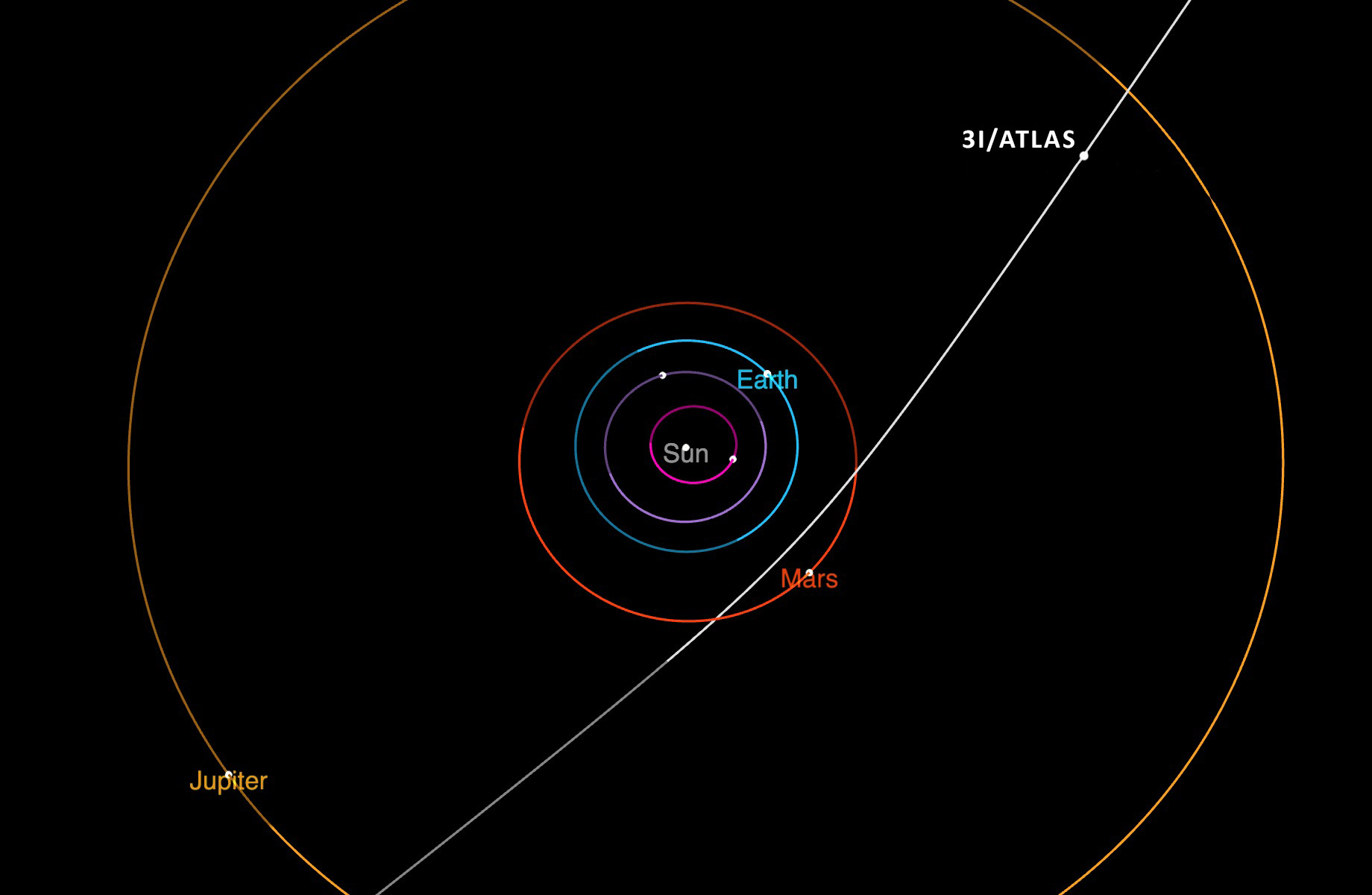
The reason it is called 3I (pronounced Three Eye) is that this is the third interstellar interloper we’ve observed1 in the past eight years. An interstellar object is one that is not gravitationally bound to any star, including our Sun. it originates from another region in the galaxy, and travels through interstellar space (the space between stars) before zipping through our solar system.
Back in 2017, 1I or ʻOumuamua was our first confirmed interstellar tourist. It was noticed by the Pan-STARRS telescope in Hawai’i, so it was named ‘Oumuamua, which is Hawai’ian for ‘messenger from afar arriving first’.
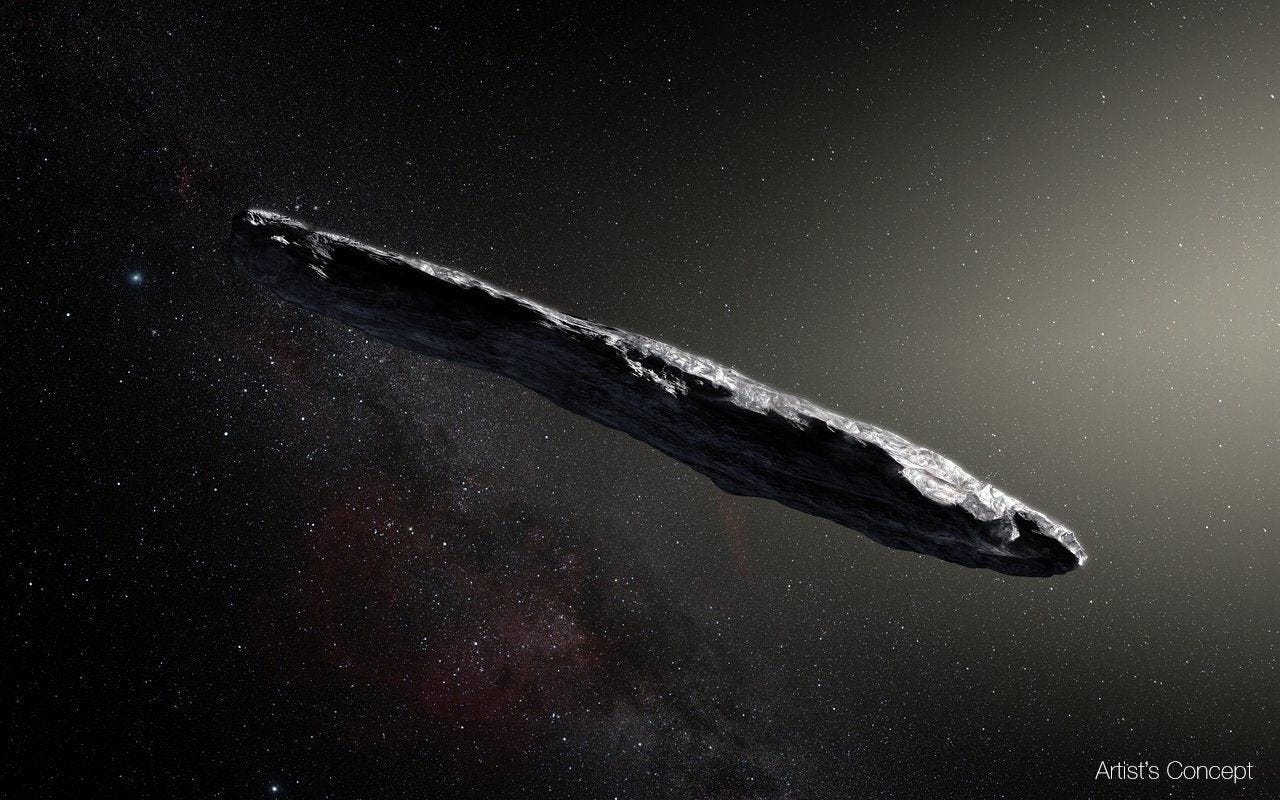
From the outset ‘Oumuamua gained a lot of attention because of its unusual shape (elongated like a cigarillo), high speed (87.7 km/s), hyperbolic trajectory, lack of a visible coma, and some indications of non-gravitational acceleration.
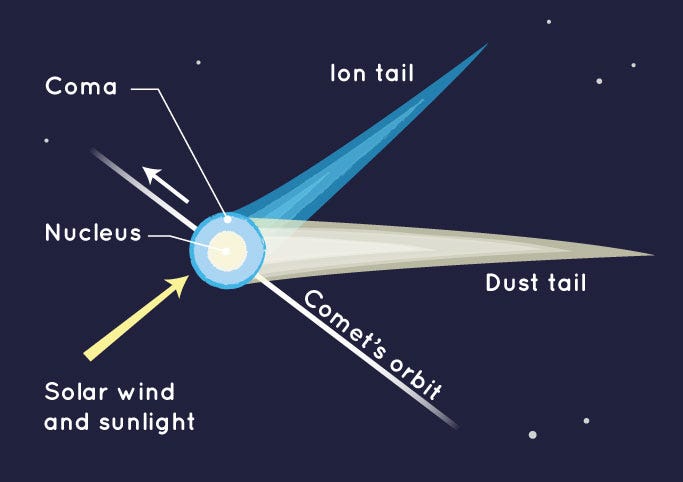
The coma of a comet is the glowing cloud of gas and dust that surrounds the solid nucleus and the hyperbolic path meant that ‘Oumuamua moved with enough velocity to escape the Sun's gravitational pull entirely.
‘Oumuamua reached its perihelion — the closest point to the Sun — on 9th of September, 2017, passed Earth’s orbit on 14th of October (at a distance of about 0.16 AU), crossed Mars’ orbit on the 1st of November, passed beyond Jupiter's orbit in May 2018, Saturn’s orbit in January 2019, and Neptune’s orbit by 2022. It left a lot of speculation in its wake about the nature of this peculiar out-of-towner.
This included a a 2018 scientific paper authored by astronomers Avi Loeb and Shmuel Bialy that ‘Oumuamua might be some kind of artificial craft, probe, or alien tech debris! It should not be surprising that this caused a whirlwind of media interest and furious debate among astrophysicists through tweets, articles, and YouTube takedowns.
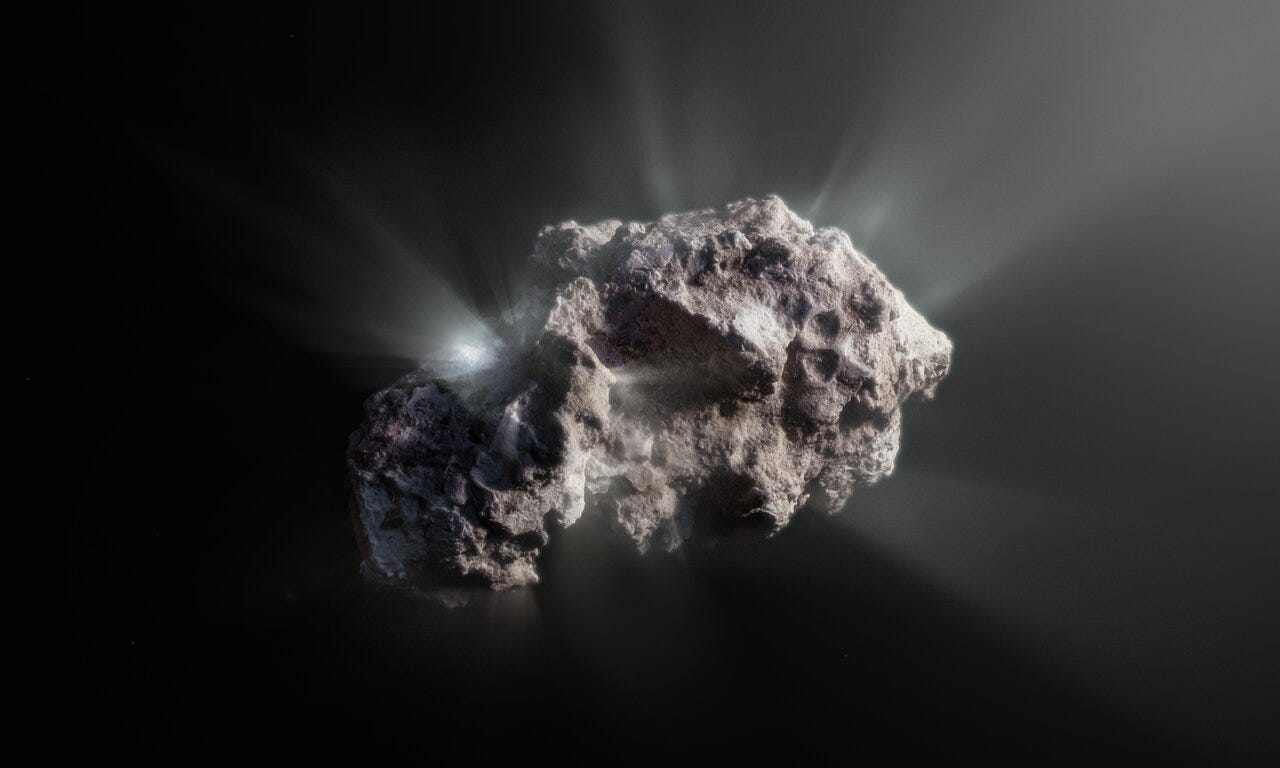
2I/Borisov was the second interstellar comet to saunter through our solar system. On the 30th of August, 2019 award-winning astronomer and telescope maker Gennadiy Borisov made the stunning observation which gave the comet its official name. He spotted the comet using a 0.65 meter telescope that he designed and built himself at his private observatory called MARGO, located in Nauchny, Crimea.
The comet travelled at roughly 33 km/s, and passed perihelion on the 8th of December, 2019, near the orbit of the Earth. While 2I/Borisov’s composition was intriguing because of very high levels of carbon monoxide, it did not stir up as many vexed arguments about overly speculative origin theories.
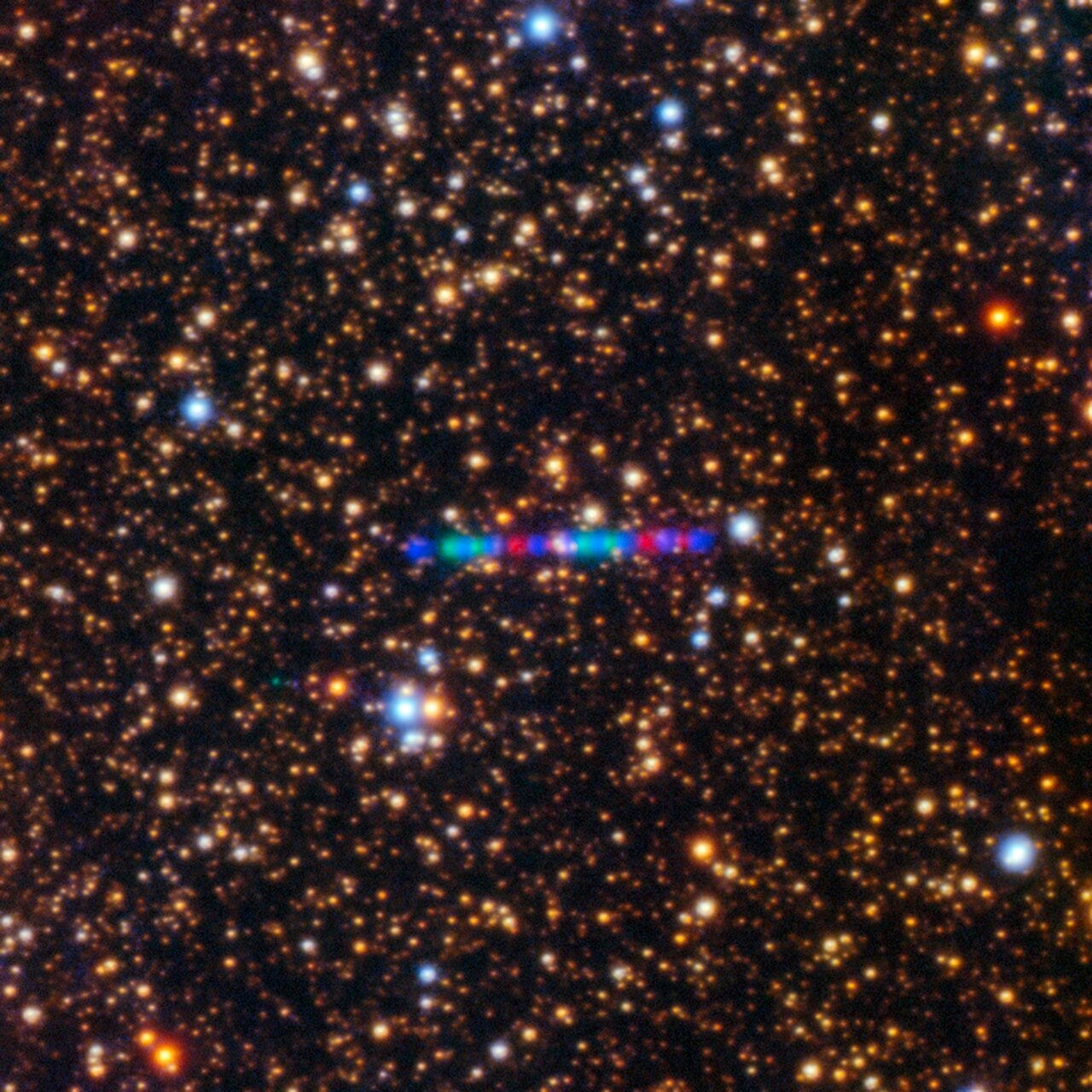
But 3I/ATLAS is causing another ruckus in the astronomical community as information pours in from telescopes such as NASA’s SPHEREx and James Webb Space. Like ‘Oumuamua, 3I/ATLAS is fast, but also significantly bigger. It’s estimated that it’s 15 (km) in diameter (that could change with more observations). If you compare it to its predecessors: ‘Oumuamua was approximately 100m and 2I/Borisov was less than 1km.
Although the consensus is that this is another, larger, interstellar comet, author and astrophysicist Avi Loeb believes the data indicates that scientists should keep all considerations open:
Alternatively, 3I/ATLAS could be a spacecraft powered by nuclear energy, and the dust emitted from its frontal surface might be from dirt that accumulated on its surface during its interstellar travel. This cannot be ruled out, but requires better evidence to be viable.
This suggestion has raised the blood pressure among his colleagues.
Further observations of the 3I/ATLAS bullet train through our solar system will provide more information. It will be observable from ground-based telescopes until September 2025, but as it starts approaching its perihelion (during Halloween) it will disappear behind the sun from our perspective. It will reappear during November 2025 when it moves away from the Sun’s glare.
It’s estimated that the comet will pose no threat to Earth, staying at a safe distance of about 1.8 AU, but it will race past Mars at a closer .4 AU.
The Psyche spacecraft will be in Mars orbit at that time and may be able to offer a unique perspective of the comet while we are sun-blind, but Psyche was not designed for this type of observation (I wrote about the Psyche mission and the mythological associations back in December 2023). NASA is staffed by ingenious problem-solvers so no doubt they will do their best, but it’s a long shot.
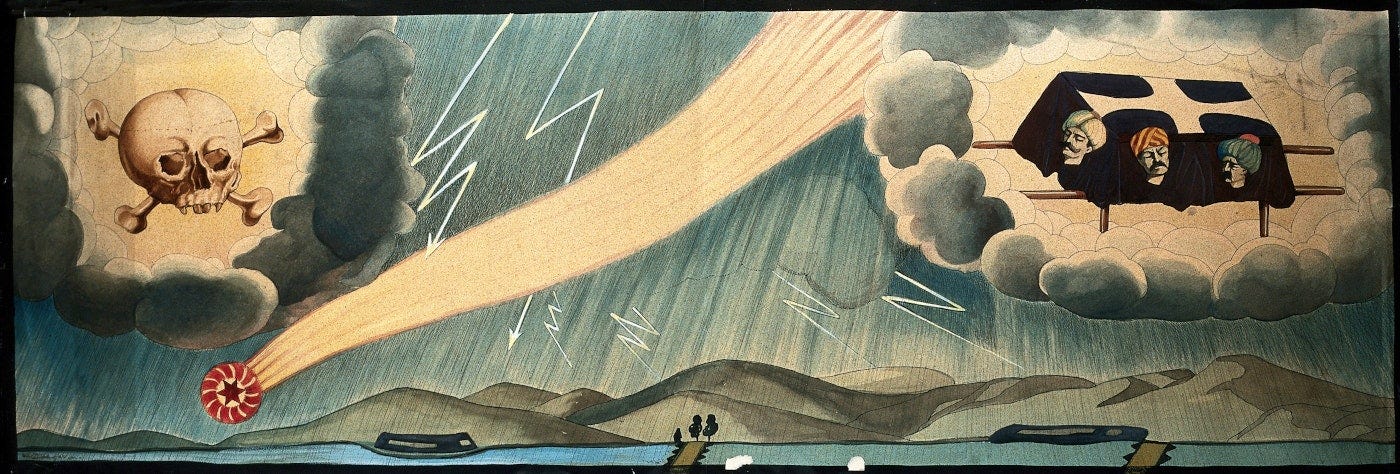
It’s worth noting that comets and unusual activities in the heavens have always caused consternation among humans. In pre-industrial eras (only a few hundred years ago) our night skies were reassuringly consistent, and much of our earliest mythological stories were mapped upon the constellations of stars. The regular movements of our wandering planets, plus the sun and moon, were observed and understood by our agricultural ancestors, who were able to plant and harvest by this stable calendar.
Bursts of meteors like the Perseids (July-August) and Leonids (November) were almost reassuring because of their regularity. These were celebrations or warnings tied to events occurring during the season.
Rare lights in the celestial realm were often seen to herald calamity or the death of a head of state. Halley’s Comet, with its 76 year orbit, usually inspired fear and dread. Its most notable coincidence was its appearance before the Norman conquest of England in 1066.
Shakespeare’s plays are replete with references to the heavens and their omens:
The bay-trees in our country are all withered, And meteors fright the fixèd stars of heaven. The pale-faced moon looks bloody on the earth, And lean-looked prophets whisper fearful change Richard II (Act 2, Scene 4)
Despite all our knowledge and our ability to peer deeper into the vast starry realms, we are unsettled by changes in the firmament.
Strange sparkling messengers provoke uneasy thoughts.
We seek surety in our stars, not roving ramblers.
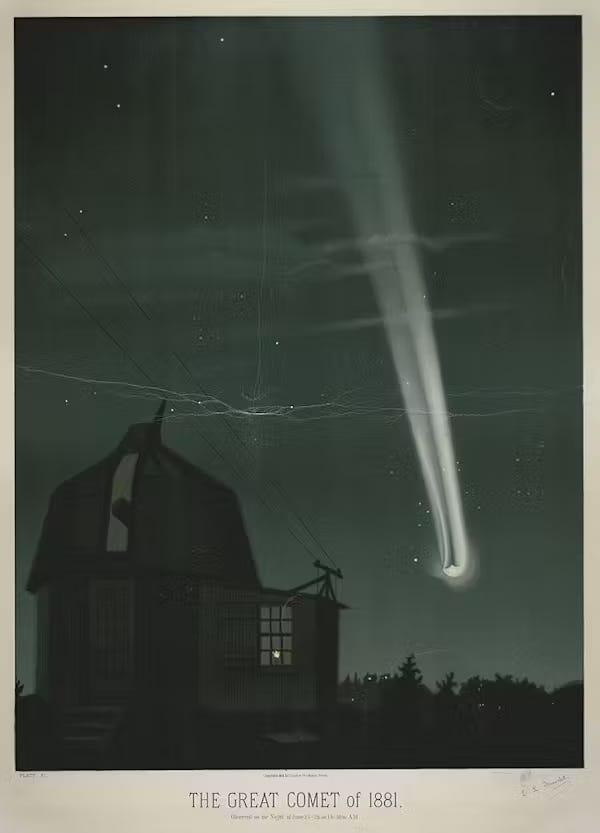
No doubt we’ve missed a lot of interstellar comets up until this point, and others may have escaped detection because there is a lot of sky to watch.
Echoes of "Rendezvous with Rama". Arthur C. Clarke was ahead of his time.