

Patricky
St Patrick arguments, saintly remains, and his enduring legends

Dear word explorer,
Saint Patrick’s Day is winding down in Ireland and I often ponder a few things during the extra greening of the isle.
First: Ireland’s foremost national holiday is centred around the life of a saint, and we don’t have one to mark the establishment of the Irish Free State in 1922 or the Republic of Ireland in 1949 (there are political reasons for this which resonate through this country today).
Second: the holiday invariably lands in the middle of Lent, one of the oldest Christian liturgical periods, which was created to establish a six-week window of fasting, prayer and reflection prior to Easter.
St Patrick’s Day, with its emphasis on out-going celebrations of ‘Irishness’, tends to be an upbeat day of fun, with parades and get-togethers. Funny enough, St. Patrick Day parades originated outside of Ireland (in the USA), and the first Irish parade took place in 1903 in Waterford, the same year St Patrick’s Day was declared a public holiday.
When I was growing up in Ireland there was an accepted agreement that everyone was given a twenty-four hour ‘pass’ on their chosen Lenten abstinence. The very faithful refused this cultural dispensation, but for children who had ‘given up’ sweets, crisps, or soft drinks, this was a day of sugary indulgence!
This is a peculiarly Irish dilemma, and we invented a loophole so a good time with friends (the craic) obtained a limited expression within a period of respectable restraint. It might explain why it can get a little manic…
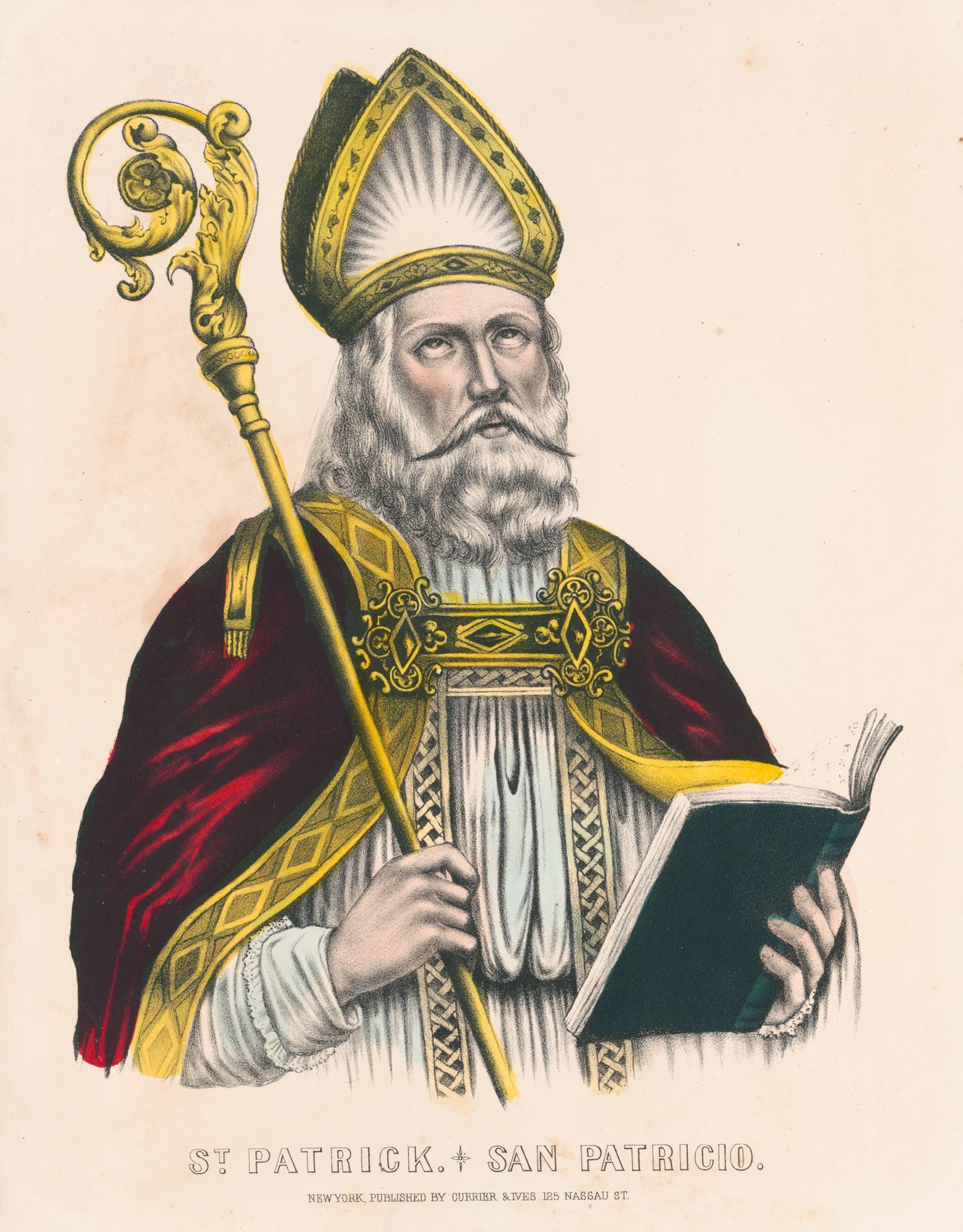
When I embarked upon my B.A. in English and History in the University of Galway, one of the first history classes I attended was ‘The Problem of Saint Patrick’.
It was a useful introduction to fresh-faced eighteen year-olds about the importance of paying attention to authorial bias, rooting out the best information about a subject from primary sources, and the need to dig through accumulated myths and hearsay. Many of the ‘facts’ that we know about Saint Patrick come from his own autobiography, Confessio, dated to the mid-5th century, which contains a sparse retelling of the highlights of his life. The first observation any researcher would note is that an autobiography is hardly an objective view of a person’s life. Although, Patrick’s account is humble and lacks inflation of his achievements.
What Patrick informs us in his Confessio is that he was born into a Romano-British Christian family, he was captured by Irish raiders when he was sixteen years old, and lived as a slave in Ireland for six years. During that period he herded sheep, and returned to his childhood faith with intense diligence to endure the lonely ordeal. Finally, Patrick was granted a prophetic dream which showed him a route to escape home, and he followed the guidance — he had several more adventures before he was reunited with his family. After becoming a priest in England, he returned to Ireland as a missionary. Christianity had already been introduced to the country, but Patrick succeeded in spreading the new religion.
In this document there is..
‘… no reference to the shamrock, no indication of snakes’ being driven out, and no naming of the mountain where Patrick tended animals as a slave (neither Slemish nor Croagh Patrick nor, for that matter, Lough Derg is mentioned); nor is there any allusion to the Paschal Fire on the Hill of Tara, or to King Loíguire. All of these ingredients, which we have inherited as part of the wider narrative of Patrick, derive from later traditions and circumstances. Over time the cult and status of Patrick took on such proportions as to flow from straightforward historical narrative into hagiographical writing (the presentation of saints’ lives), popular folk-beliefs, and legends, all reflective of the times in which such traditions emerged.1
Prior to Patrick’s arrival in Ireland, the first bishop was the Frenchman, Palladius, and it’s possible that some of his exploits were later conflated with Patrick’s adventures, but it’s not a clear case.
What I remember most from my course was the loud confrontation one afternoon between an older mature student and our lecturer over the material. As I remember it (autobiography is often inaccurate!), the man was a devout retired Irish-American who was taking his first university degree. He took extreme exception to the idea that some of the stories about Patrick could be ‘embellishments’.
The lecturer remained calm despite the student’s escalating anger, and eventually the student stalked off in a fury.
I was less surprised by the fanciful yarns, perhaps as a result of living in Ireland: this is a island of mythmancers, and no story remains intact after the first telling. It shouldn’t surprise anyone that after several centuries some of the first stories written down about St Patrick were by ecumenical centres keen to inflate his value as a venerable person and to cement their association with him.
Most of the histories of early Irish saints involve magical feats, visions, strange encounters, tough tests and mystical healings so this was the usual weirdness of those afflicted with profound spiritual experiences in Ireland during a period of cultural transformation.
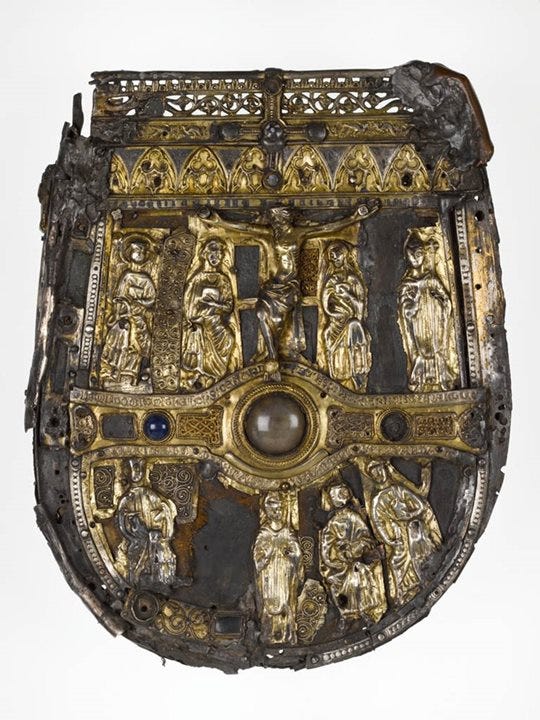
Patrick is purported to have died around 461, but some of his remains were enshrined. Probably.
The Fiacal Padraig or ‘Shrine of St Patrick’s Tooth’, is a reliquary of wood, copper alloy, silver, gold and silver filigree, rock crystal, glass and amber, which claims to hold a tooth of Saint Patrick. The vessel originated in the 12th century and was further modified in the 14th century — rather a long time after the saint passed away. According to 9th century sources, St Patrick began to lose his teeth in his later years, and one of them was kept in a church in Silgo, and later safeguarded in a church in Athenry, Co. Galway. In the 18th-19th centuries the shrine was used to cure sick animals. It was eventually purchased and passed into stewardship of the state.
But that’s not the only preserved section of the saint…
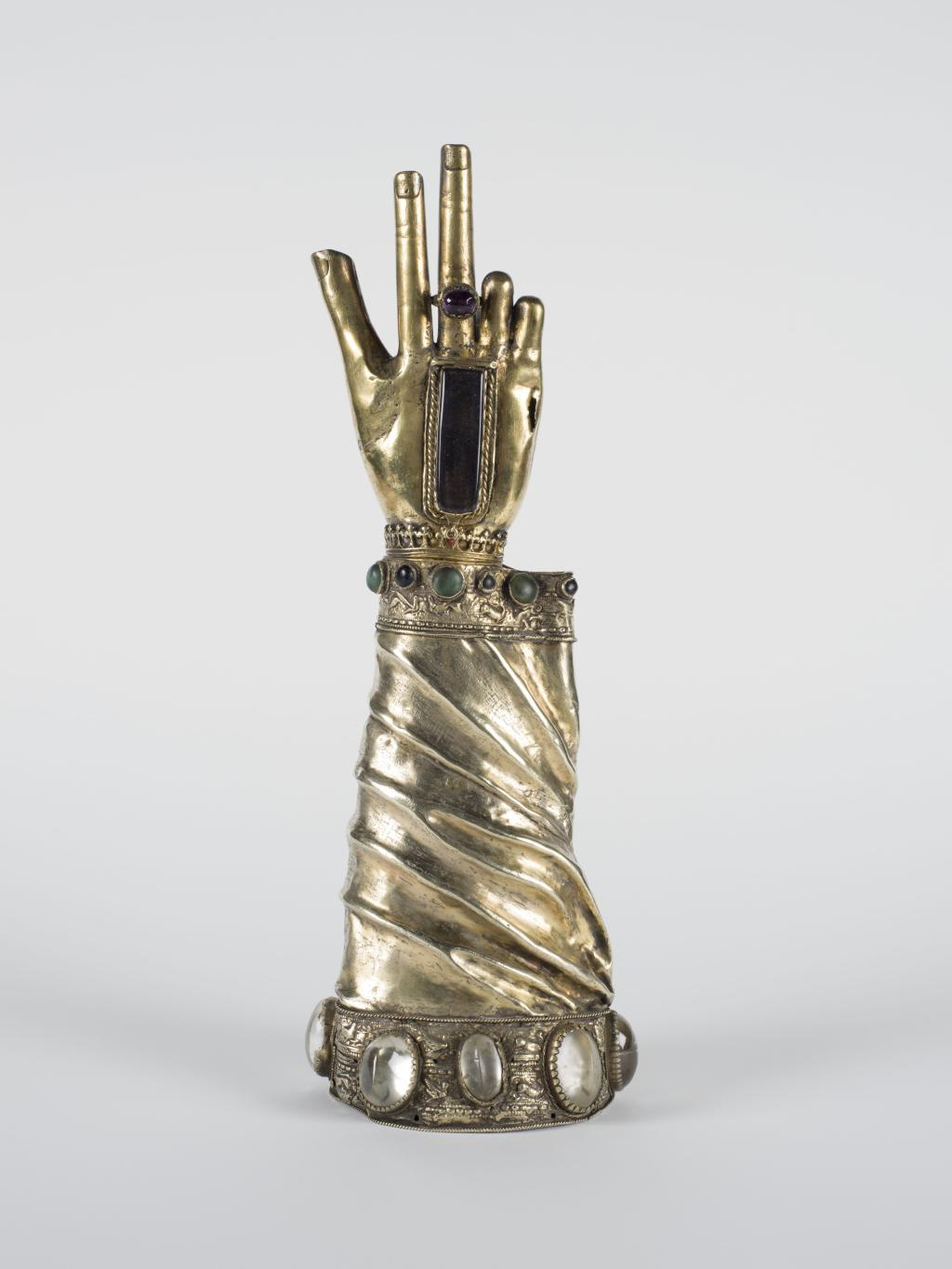
The Shrine of St Patrick’s Hand is on display in the Ulster Museum in Belfast, and is one of two arm-reliquaries in Ireland2, but both of them are now empty.
Made of gilt silver, the shrine depicts a sleeved right forearm and hand in the position of a blessing. It is decorated with die-stamped animals and a series of green, blue and black domed glass studs.
There are another five oval studs, one of rock crystal and the other four of clear glass, decorating the bottom of the shrine. The animal ornament includes a pattern of two lions, two griffins and two stags, which is characteristic of Irish art of the Middle Ages. These details demonstrate the shrine is of Irish origin, enabling us to date the reliquary to this period.
While this practice of creating jewelled containers for holy people’s remains might seem bizarre to modern people, it’s a tradition that appears across the world in many religions.
There is a wide range of Catholic relics (from relinquere ‘to leave behind’), and they are usually organised into three distinct types: first class (the body or fragments of the body), second class (an item the saint touched or owned), and third class relics (an item that has been touched by a second class relic).
So the Irish arm-reliquaries were originally first class but are now second class.
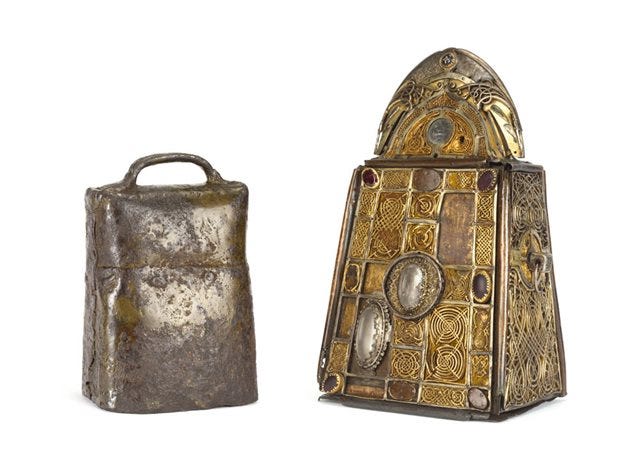
Another second class relic is the Bell of St Patrick and its Shrine, also held in the National Museum of Ireland.
This hand-bell (clog) is constructed from riveted iron plates coated in bronze. The Annals of Ulster record that St Columcille opened the tomb of St Patrick to recover Patrick’s goblet, Gospel, and ‘Bell of the Testament’, and sent two of the treasures to churches and kept the Gospel for himself. He declared he was under angelic instruction so the grave robbing was divinely sanctioned. Irish saints were a wild bunch.
The beautiful, ornate Shrine for the bell was fashioned around 1100 CE.
Most astonishing, is how the item was recovered:
At the beginning of the 19th century, the last member of the Ó Maellchallain family, a priest about to die without heir, sent for his former pupil, the Belfast merchant Adam McLean. He told McLean to dig at a certain spot in his garden, where he found this bell enclosed in the magnificently ornate shrine that was made for it in Armagh around 1100. The Ó Maellchallain family had been “keepers of the bell” since medieval times.3
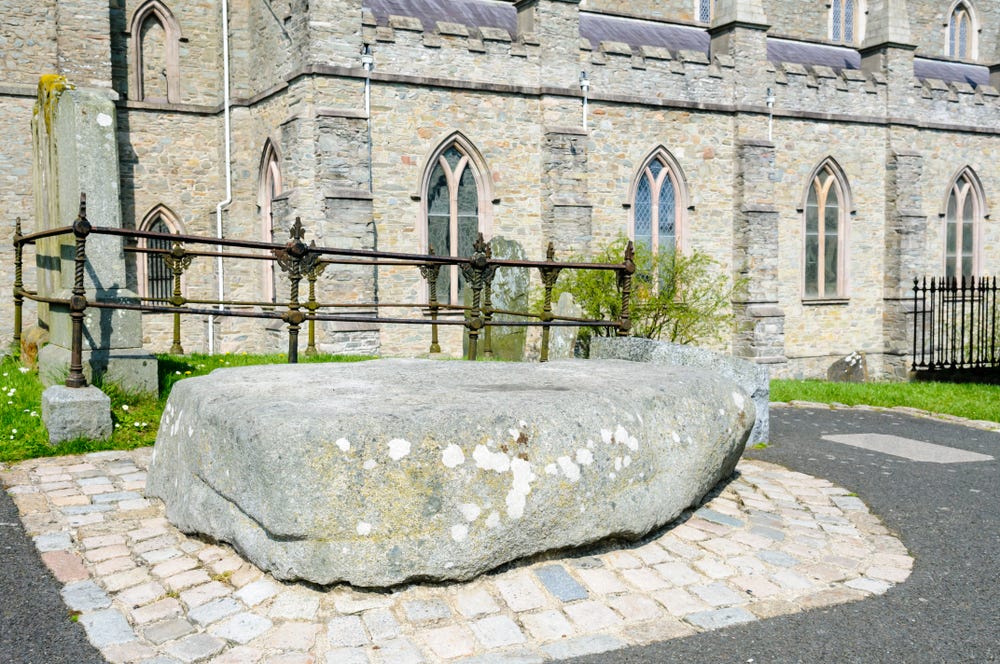
The greatest question is where is the grave of Saint Patrick (after he lost his teeth and an arm)?
It is claimed that Patrick is buried outside Downpatrick Cathedral. A large granite stone marks the spot, placed there in the early 20th century to prevent pilgrims from taking fistfuls of grave-soil away with them. However, the tradition of Patrick’s burial at this location is influenced by late 12th century propaganda (some 700 years after Patrick’s demise) by the Anglo-Norman John de Courcy. Understanding the deep-rooted appeal of the cult of relics and the important role of saints as patrons to the local people, de Courcy staged the "discovery" of the relics of saints Brigit, Colum Cille and Patrick in 1185. He exhumed their bodies and translated the relics into a new tomb at Downpatrick. 4
This need to acquire the Patrick imprimatur indicates the strength of St Patrick as a symbol of spiritual authority in the Irish imagination. Many other locations in Ireland are rich with saintly stories such as him wrestling with the Devil (at the Rock of Cashel), fasting for forty days (at the top of Crough Patrick), discovering an entrance to Purgatory (Station Island in Lough Derg), and other tales involving rocky chairs, wells, and hills around the country. He is embedded in the landscape and the naming of places and people. ‘Paddy’ is a shorthand for Irish people: amusing or infuriating depending on the context. What is character and what is fabrication?
Inspired by Spain’s Camino de Santiago, in 2015 Saint Patrick’s Way was established: a 132km walking trail in Northern Ireland from Armagh to Downpatrick, which links places associated with Patrick’s life, and ends at his burial site. Walking a pilgrimage remains a potent act — as mentioned in last week’s newsletter and in a previous one about ‘Endurance’. The purpose of the journey is clear, the body is occupied, and the mind shifts through its self delusions and truths.
When pilgrims are walking the quiet stretches, with only sheep on the pastures observing their slow passage, they are closest to epiphany.
‘St Patrick’s Writings: Confessio and Epistola’ by David Kelly.
The second one is the Shrine of Saint Lachtin’s Arm (c. 1118–1121 CE, National Museum of Ireland). A bronze-gilt reliquary depicting a clenched fist, which may have been carried into battle as a protective talisman (it’s fun to speculate!).
‘A History of Ireland in 100 Objects: St Patrick’s Bell’, Fintan O’Toole.
‘CSI St Patrick: just where is the saint’s body?’ by Dr Niamh Wycherley.
Loved this piece; I'm a sucker for the medieval saints!
Cray cray people in classrooms stalking off because they don't want to hear the truth! Sounds very much like he didn't belong in Ireland or in that classroom for that matter. I will admit the golden urns creep me out but we have my mother's ashes in a clock right now. I do want to sprinkle her ashes at the Jersey shore though someday, her favorite place was Sea Isle City, NJ. I wonder where St. Patrick would want to be sprinkled if he could be now? Where could the hand go?! Ha. Hope you have a great rest of your week! Xoxo. 🍀♥️