

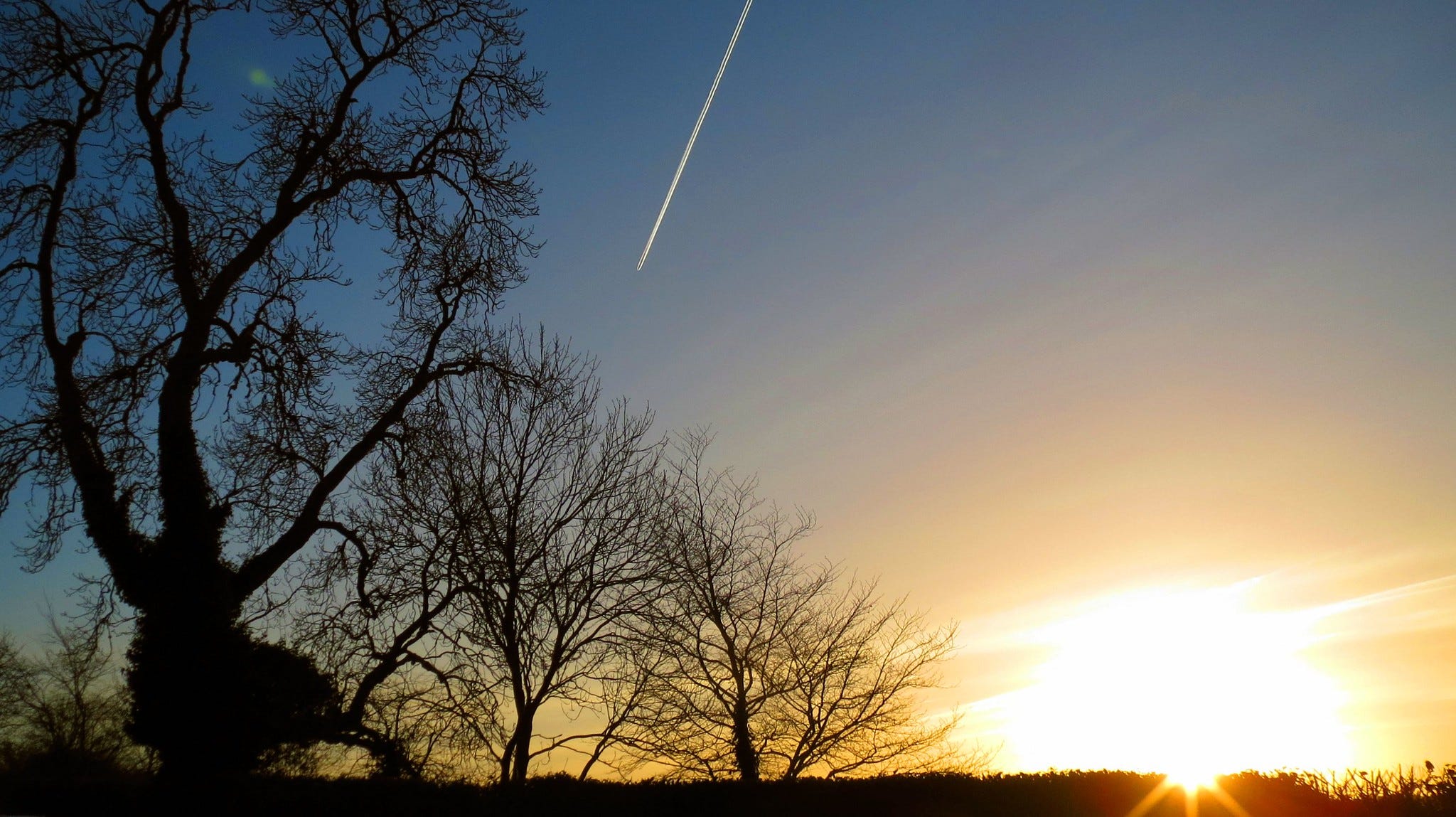
sun pause
can we clear a moment to rest and reflect during this period of stillness?

Dear word explorer,
I hope you are well today; I’m recovering from a cold that flattened me for much of last week. I had to accept being a factory of phlegm and coughing like an clapped out horse even though the timing of the illness was highly inconvenient. Does sickness ever arrive at an opportune moment? Of course not! You are benched beside boxes of tissues and hot toddies, and it would almost be enjoyable if not for your enfeebled aching state. I’m on the upswing now, except for occasional sneezing.
Thanks to everyone who chimed in on my post that discussed the ‘Right to Repair’ movement, and I’m delighted to introduce some of you to this sensible drive to mend the broken items in our lives (and to give us the legal option to do so).
As I’ve mentioned before (in my Tech Woes post from last year) this is a geeky household, so we always try to upgrade and fix kit that breaks or goes wonky. Back in the day, it was cheaper to buy a computer in parts and Martin assembled the PC himself. Thus making it easier to swap in new elements as needed. Over the years we have donated many of our older laptops and computers to other people by refurbishing the machines and bringing them back to a basic software setup. For someone without the resources, getting a computer that can handle the fundamentals is a huge blessing.
As discussed last week, manufacturers have made tech repairs increasingly difficult, in particular on the software front. Martin and I continue to use technology for as long as possible, and resist ‘upgrades’ that are for flashy but spurious reasons. I’m a believer in letting the hardcore fans splurge their cash on the first iteration of a technology, and to wait for the bug fixes and updates to roll in until the second iteration is more robust. I like to buy around version 2.5 just as 3.0 or 4.0 comes out, when it hits a decent price point for a well-tested device.
I’m not immune to lusting after the latest sparkly gadget, but I generally have a strong ‘Do I really need this?’ counterbalance to the desire.1 Once I have answered in the affirmative with good reasons I am quite swift with the purchase!
I will mention one recent piece of adjacent news: LG announced it will no longer make Blu-ray players, which means the availability of physical machines and physical media is rapidly declining. This comes after the decision by Microsoft to make the disc drive optional for the latest Xbox Series X consoles, as did Sony for the PS5 Slim/Pro. The assumption going forward is that digital/streaming media is replacing physical media and soon no one will want their wall of discs. Currently, there remains a vibrant market for high-quality special editions of movies on DVD/Blu-ray formats, but perhaps in another generation this will be for the showcases of antique collectors and museums only.
It underscores the consumer’s problem of dependency upon streaming services to keep their catalogues of movies and TV shows online and intact. It will become easier for these streamers to erase the existence of whatever film/TV show they think is not worth maintaining for whatever reason they determine. Once there is no physical copy of the material available it is easy for these stories to vanish from the cultural collective.
I didn’t want to bloat out the previous newsletter, but the obvious practice to reference in relation to mending and repairing is Kintsugi — the Japanese art of fixing broken ceramics, usually with the cracks painted gold so they are visible. This word comes from the Japanese kin (gold) and tsugi (patch). This slow process is one of meditation upon the broken vessel and accepting that imperfections are a condition of living.
In the video above, Hiroki Kiyokawa, a restorer in Kyoto, observes:
I think our broken parts can be mended. So we should never give up on life. Try not to hide what you’ve gone through and your history, even if it was a big accident. You should embrace it. And you will be reborn because of that accident.
This also arises from the Japanese philosophy of wabi-sabi, which is a tricky concept to translate as it is a composite that evokes an array of emotions and understanding. Via Hikarui’s web site you can fully read the complexities of the etymology of its largess, but the summary is:
‘the appreciation of the transient beauty of things imperfect, impermanent and incomplete in the physical world.’
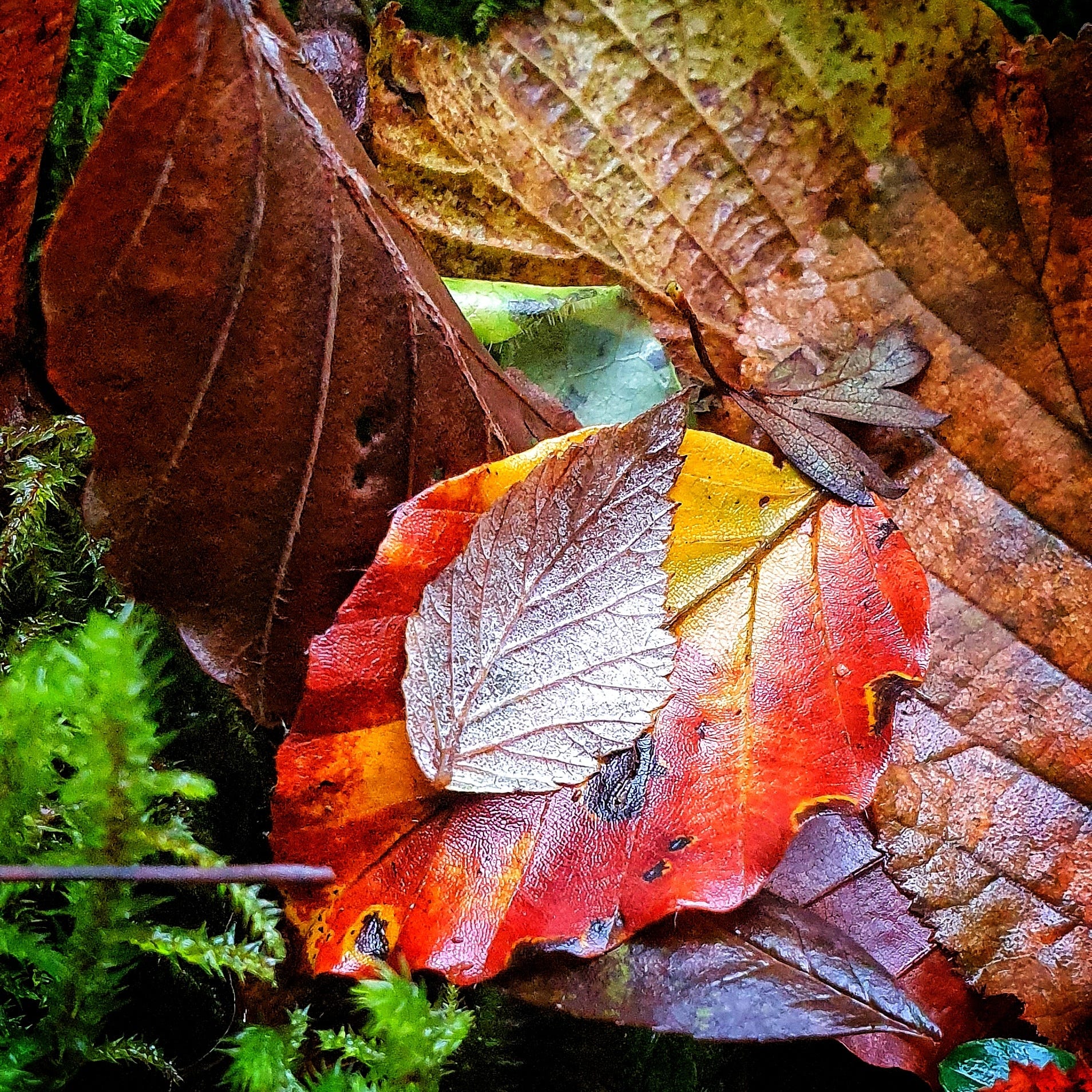
It is a reassessment of what we deem ‘beautiful’. I can see majesty in nature’s diorama of decay in late autumn, as summer’s foliage breaks down into mulch to feed the next generation of life, planted in the cold earth below.
As we approach midwinter, the seeds in the ground are dormant, and within each resides the pattern of an entire lifeform. Beneath our boots the next revival waits for its signal to emerge.
In these dark days hope isn’t visible, but it exists, waiting…
It is a strange dichotomy of the modern world that we tend to be at our busiest and most frenetic as the winter solstice approaches, around which a gaggle of celebrations cluster. It’s not a new impulse to plan social hi-jinks during the shortest days, since it is a useful release of winter cabin fever, and a reminder that the light is returning to the world.
The 17th of December was the traditional start of Saturnalia, the old Roman festival that grew to encompass seven days of frolics, rowdy behaviour and role reversals, where the lowest caste was temporarily raised up, and fools were paraded as wise advisors.
It is named after the god Saturn, who is often depicted with a sickle, since he is the one who reaps the harvest of labour—i.e. you must put in the work before you can enjoy the bounty. He’s the Roman equivalent of Kronos, and their mythologies have similarities. Both of them ruled a golden age before it was passed on to their divine children. This was usually described as a generative transition for Saturn, but violent for Kronos.
In many ways fear is the great destroyer of Kronos.
Kronos had to overthrow the rule of Uranus, his father, in order to reign, so when it was prophesied the pattern would be repeated, and Kronos’ children would rise up against him, Kronos believed it. This points to the problem of rebelling against tyrants and establishing ‘a new order’ which may later succumb to similar oppression. If you only experience the rule of despots, can you establish (or even imagine) a fairer system? It has taken humans many, many generations to evolve toward democratic ideals or to accept the notion that every individual has the right to freedom.2
Gripped by the fear of losing the power he viciously earned, Kronos ate his own children. You could draw a parallel between that act of consuming one’s offspring to inhibit progress with today’s trends in the technology sector, where companies grow fatter from the absorption of new competitors. The tech upstarts of decades ago have become the overbearing, gigantic monsters of the present, scanning the horizon for fresh challengers, prepared to hobble whomever they can’t devour.
In the myth it is only through the stealth of the mother goddess Rhea and the power of Zeus that Kronos was forced to regurgitate his (still living) progeny and face them in battle.3 When Zeus and his siblings eventually triumphed, life was good for them, but not necessarily for the humans they ruled!
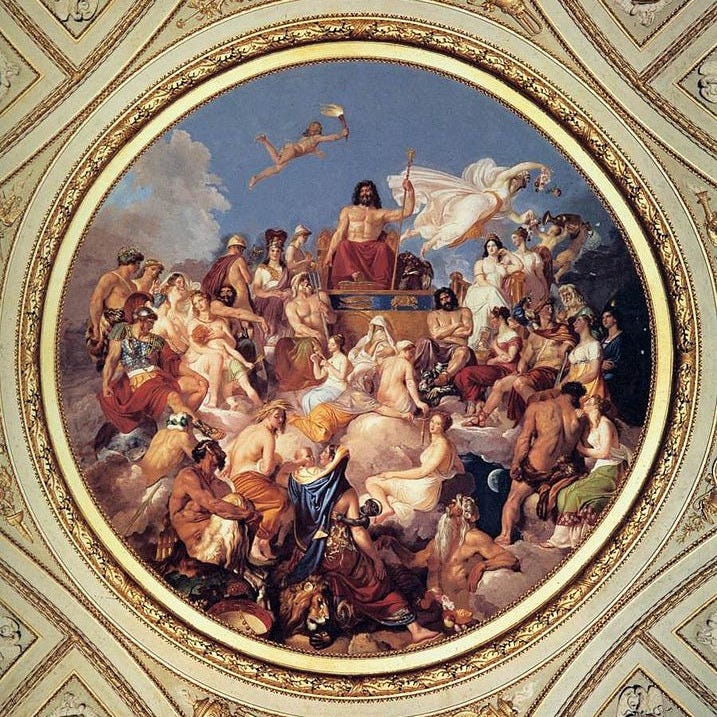
Thankfully, mythology is also full of stories of the apostate divinity or the sly trickster who sides with humans and the semi-divine heroes who struggle through trials to achieve their destinies. The powerful can be contested, although it helps if you are pals with a secret power and have a couple of magic items in your satchel.
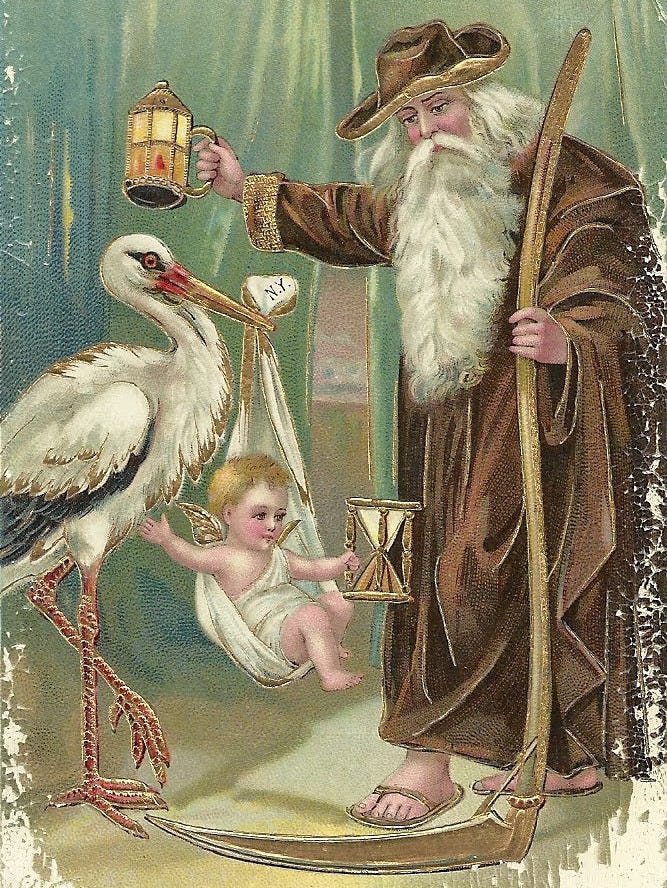
Finally, a reminder that Kronos is often depicted with a scythe, and his name translates as ‘time’. His symbol merged with Saturn and evolved into Old Father Time, the ancient reminder of Tempus Fugit — time flies. He has long been associated with end of the calendar year, and the perpetual cycle of death and rebirth.
Kronos simply exhales his final shuddering breath at the last second of the year, gives up his power and wisdom, and inhales as the cherubic infant, already pondering fresh starts.
It’s a far more enlightened method of transformation!
The word solstice comes from the Latin solstitium, which can be translated as ‘sun standing’. In Irish, it is grianstad, which essentially means ‘sun stop’. This is because the sun’s movements will not alter for three days around the 21st of December. Our astronomer ancestors noted this pattern a very long time ago since the dictates of the natural world ruled their lives.
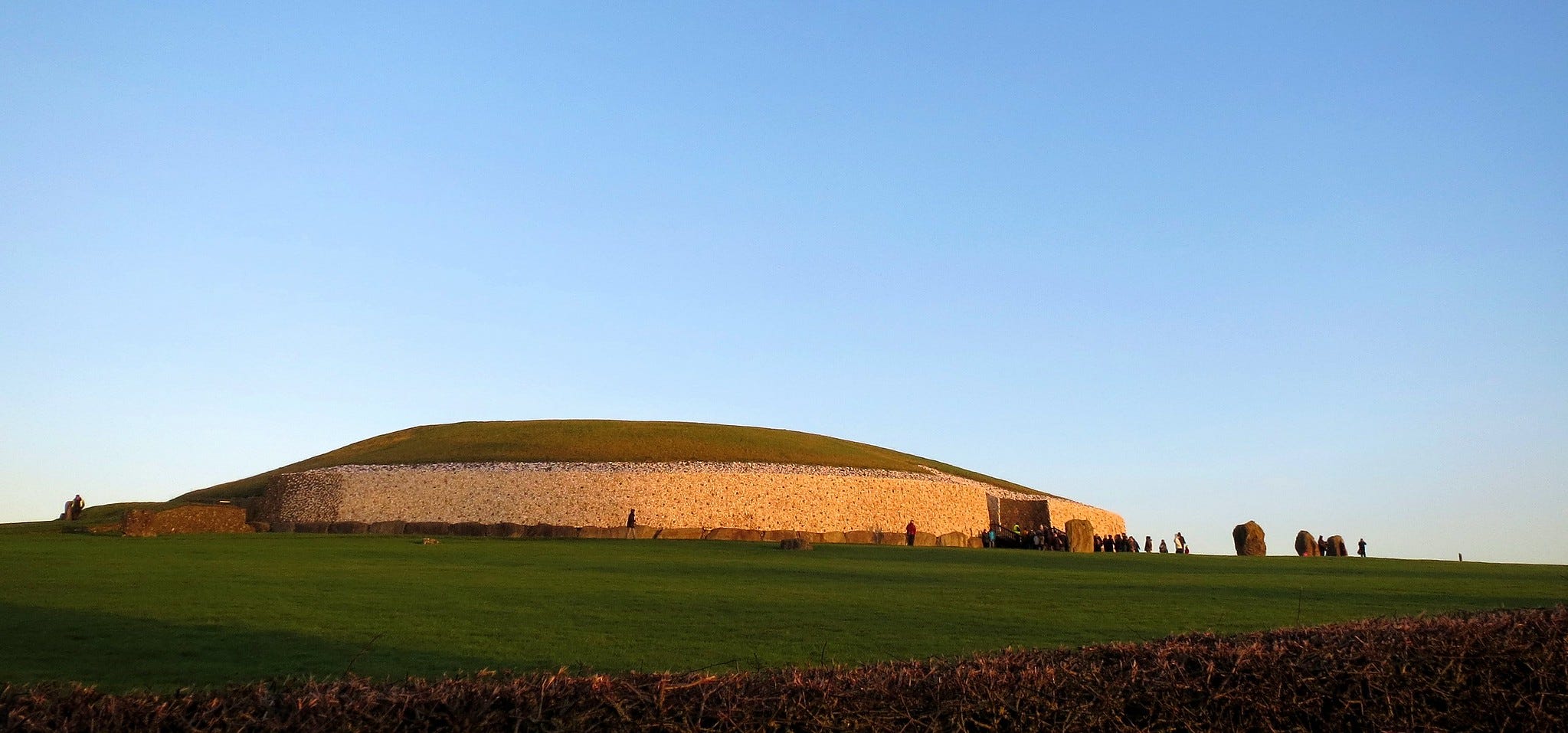
Ireland has one of the largest concentration of megalithic burial sites and standing stones in Europe, and the vast majority align precisely with astronomical events. The most famous being the Newgrange passage tomb, built circa 3200 BCE. It is a massive kidney-shaped mound covering approximately one acre, ringed by 97 kerbstones, some of which are highly decorated. The 19m long inner passage leads to a cruciform chamber with a corbelled roof.
Above the entrance to the passage at Newgrange there is a roof-box opening which allows sunlight to penetrate the chamber and illuminate a carved tri-spiral motif during the three shortest days of the year. It has been doing this perfectly for over 5,000 years. Every year there is a lottery system which randomly selects a small group of people to be present inside the chamber on those three special mornings—many more are allowed to assemble outside to watch the sun rise over the rive Boyne and shine upon the Brú na Bóinne UNESCO World Heritage site.
A decade ago on a frosty solstice, I was fortunate enough to be among the awe-struck visitors, standing outside that ancient monument and cheering as the sun rose.
The Office of Public Works (OPW) and National Monuments Services (NMS) in Ireland will livestream the Winter Solstice from inside the passage tomb on Saturday, 21 December from 8.40am (Irish Time) via youtube/opw. The livestream will be accompanied by a narration by Dr Clare Tuffy and Dr Frank Prendergast, which will guide viewers through the event.
As the sun appears to repeat a static pattern through our skies, I feel we are being invited to participate in this time-between-time and create moments of stillness. Do we need to rush to the shops again? Is it possible to generate quiet moments in between the babble and tension?
What is the better gift: presents or presence?
Can we wind down and journey inwards with the sun?
For three days it can warm the seeds within, with next year’s hopes imprinted upon them.
What do you wish to grow in 2025? Now is the time to plan it.
Wishing you all a Merry Midwinter!
Plus, an even stronger question: ‘Can I justify or afford this outlay?’
Yes, I know, democracy has its issues, but it’s vastly better than most alternatives.
Anti-trust/competition laws strike me as analogous here. I think it’s fascinating that Themis is the Greek Goddess of Law, who carries the Scales of Justice, and her statue appears on most courthouses. She was one of the Titans released from the belly of Kronos thanks to Rhea and Zeus, and helped overthrow her father.
Thanks again Maura, will tune in before heading out to sing in our 'good energy choir' against the fossil fuels industry. I invested in a Fairphone 5 last year.
Season's greetings and keep up the great writing. Have you managed to catch Chaos? Brilliant acting...x
I am stunned by the depth and breadth of your writing. Always fascinating, thank you for all of your hard work!