

hare hopping
more stories of refuge, magic and faith

Dear word explorer,
The Spring Equinox arrived in Ireland with a welcome blaze of sunshine and the collective mood of the country leaped like a March Hare. It didn’t break 20° Celsius but I spotted a woman wearing flip-flops, men wearing shorts, and a woman in a string tank top. People were licking ice cream cones, and everyone had their sunglasses on and exuded a happy, chill vibe.
It reminds me of the time I visited Athens, Greece in early November when the temperature hovered between 17-20°C. I was breezing around in a sundress and sandals while the locals wore scarves, boots, and coats and regarded me with bemusement.
We don’t experience sunny days like this very often (cue today’s blustery mixed-bag), so many Irish people heed Horace’s advice in Odes 1.11, and carpe diem!
Ask not ('tis forbidden knowledge), what our destined term of years,
Mine and yours; nor scan the tables of your Babylonish seers.
Better far to bear the future, my Leuconoe, like the past,
Whether Jove has many winters yet to give, or this our last;
This, that makes the Tyrrhene billows spend their strength against the shore.
Strain your wine and prove your wisdom; life is short; should hope be more?
In the moment of our talking, envious time has ebb'd away.
Seize the present; trust tomorrow e'en as little as you may.1
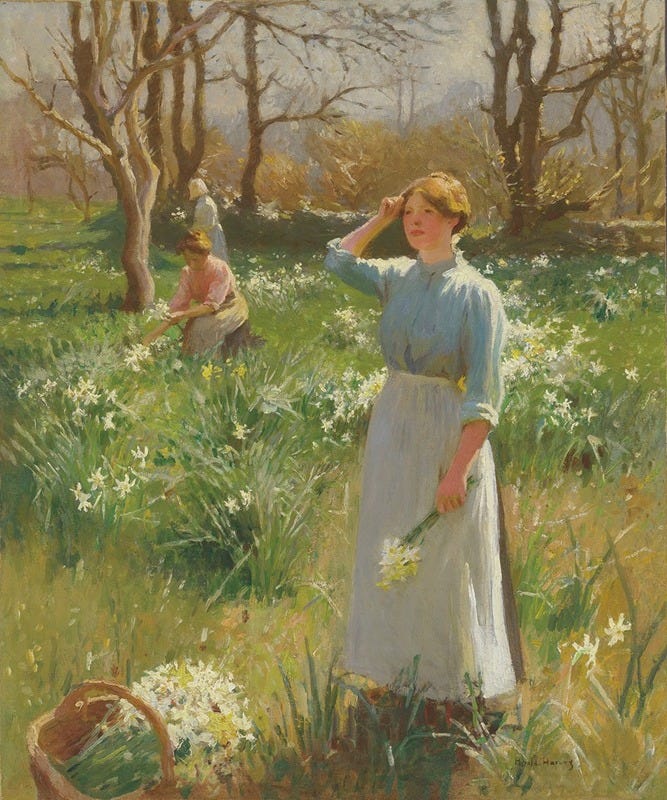
There has been a bumper crop of daffodils this year. Under the ragged hedgerows and along pastoral stretches phalanxes of their yellow heads have been bouncing in the brisk March breezes. I’m not sure there is a more uplifting sight after a dull winter than swatches of living daylight dancing in the damp ditches, especially on grey February days when they first begin to emerge.2
And what a beautiful painting I discovered — among many — when trying to find an atmospheric depiction of the spirit of Spring. It’s by Harold Harvey, a Cornish artist who was born in Penzance and studied in France before returning to Cornwall and setting about his career.
I’m going to divert a little here (zig-zagging like the March Hare), and ponder that beautiful town name, Penzance. It sounds atypical for a town in that region, and thanks to its position at the tip of the Cornish leg dipping into the English Channel (or as the French refer to it, La Manche, ‘the sleeve’) I always assumed there was some Gallic connection — mais non et mais oui!
Penzance comes from Pen Sans or ‘holy headland’ in the Cornish language. Cornish is is part of the Celtic language tree, but the Brythonic branch that contains Welsh, Breton and the extinct Cumbric. A long time ago I knew a proud Cornish man living in Ireland who was adamant that Cornwall was a separate nation to Wales and England. It’s likely that the name derives from the Iron Age Cornovii tribe that originally occupied the area, and fought the Roman invasion (and Irish raids), the Saxons, and the later rule by the Normans. Certainly their history is one of resistance.
The Cornish flag is a white cross on a black background, and is known as St Piran’s Flag. He’s the patron saint of Cornwall… and remarkably we’ve returned to the topic of last week’s newsletter: strange tales of early Irish saints!
First off it’s likely that there’s been conflation between ‘the first apostle of Ireland’, St Ciarán of Saigir, and St Piran. Like last week’s St Patrick’s tales, we’re in ‘don’t let the truth interfere with a good story’ territory. According to some sources Ciarán predated Patrick, and in others he is one of Patrick’s disciples. No doubt much of this comes from the equivalent of inter-county jostling to lay claim to the ‘best saint’. His feast day is the 5th of March, a good twelve days before St Patrick’s Day, which seems like divine timing.
Ciarán was a performer of miracles, loved to live close to nature, and was friends with animals. According to one story he blessed a well so that “it had the taste of wine or honey for everyone who drank it got drunk as well as filled“.3 A Saint who would be welcome at any party!
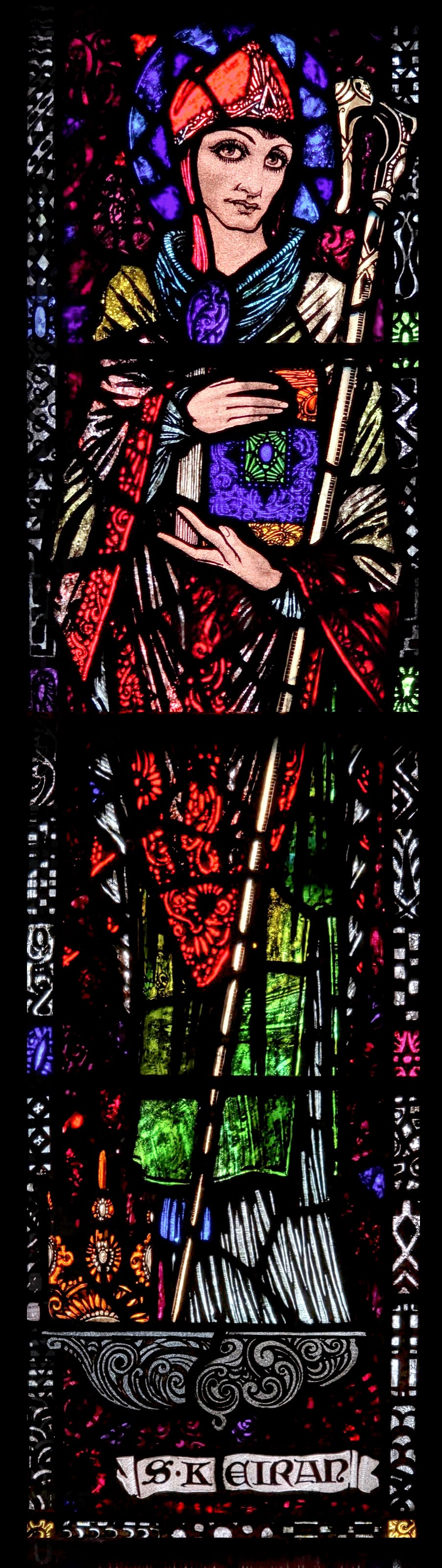

The story of how the Irish saint Piran arrive in Cornwall is a fantastic yarn:
GOOD men are frequently persecuted by those whom they have benefited the most. The righteous Piran had, by virtue of his sanctity, been enabled to feed ten Irish kings and their armies for ten days together with three cows. He brought to life by his prayers the dogs which had been killed while hunting the elk and the boar, and eyen [sic] restored to existence many of the warriors who had fallen on the battle-field. Notwithstanding this, and his incomparable goodness, some of these kings condemned him to be cast off a precipice into the sea, with a millstone around his neck.
On a boisterous day, a crowd of the lawless Irish assembled on the brow of a beetling cliff, with Piran in chains. By great labour they had rolled a huge millstone to the top of the hill, and Piran was chained to it. At a signal from one of the kings, the stone and the saint were rolled-to the edge of and suddenly over, the cliff intd the Atlantic. The winds were blowing tempestuously, the heavens were dark with clouds, and the waves white with crested foam. No sooner was Piran and the millstone launched into space, than the sun shone out brightly, casting the full lustre of its beams on the holy man, who sat tranquilly on the descending stone. The winds died away, and th~ waves became smooth as a mirror. The moment the millstone touched the water, hundreds were converted to Christianity who saw this miracle. St Piran floated on safely to Cornwall; he landed on the 5th of March on the sands which bear his name. He lived amongst the Cornish men until he attained the age of 206 years.4
The beach in Cornwall where Piran landed was later known as Perranporth Beach. Determined to take his unexpected voyage as a sign of his next mission, the exiled saint built his oratory on the spot and dedicated his life to contemplation. According to legend his first congregation were loyal animals including a badger, a fox, and a bear.
He’s also the patron saint of Tin Mining, because the story goes he built his hearth from local black stones which bled bright white liquid when he lit his first fire. The white cross on a black flag is meant to represent this fact.
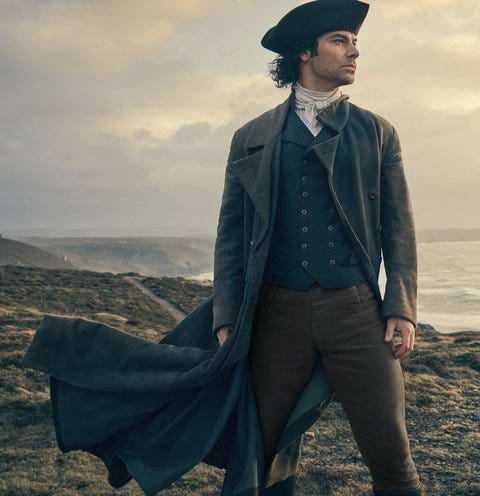
This reminds me of the famous Poldark series of historical novels set in Cornwall, written by Winston Graham, and features Copper mining. It was adapted to TV by the BBC in 1975–1977, and once again from 2015—2019. In this regard Ireland exported another icon to Cornwall when Irish actor Aidan Turner played the lead role of Ross Poldark.
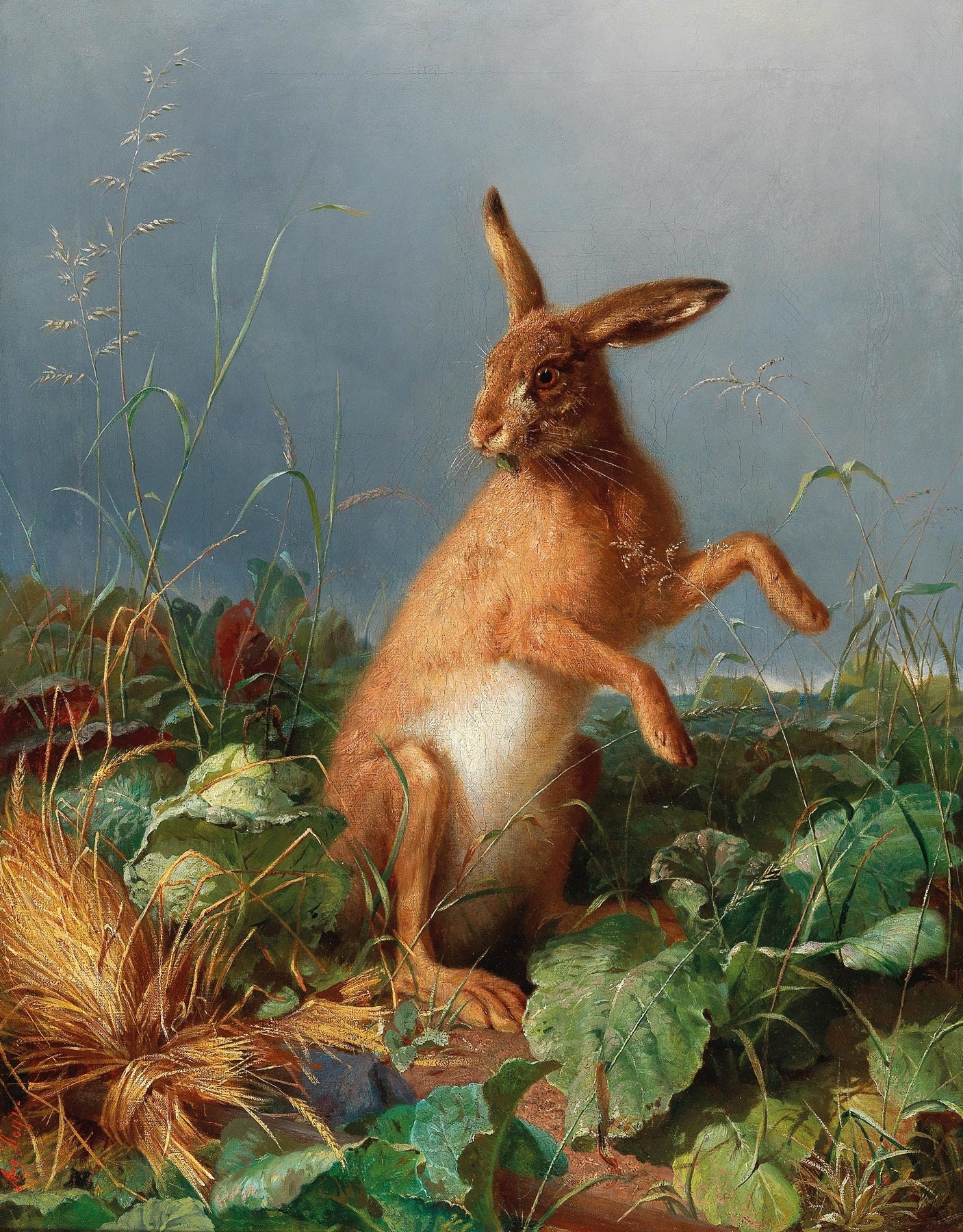
My hare hopping across subjects brings me back to the beautiful animals themselves, since the Irish Hare is a unique native species of lagomorph (hares and rabbits) — the two imports are the Brown Hare in Northern Ireland and the rabbit which pops up everywhere. The most beautiful Irish Hare rarity is the Raitlin Island ‘Golden Hare’, which has a gingerish hue and blue eyes!
The famous boxing activity of the hares in March is actually the larger females beating back overly bothersome male attention. Since hares don’t burrow, but rest in shallow depressions in long grass, heather and under bushes called ‘forms’ their babies (leverets) are born fully furred and with open eyes. Concealment and sudden speed is the main defence of the Hare. Mothers only visit their leverets to feed them once or twice a day, otherwise they are left alone to hide. They are fully weaned within twenty-one days, and hares can have two to three pregnancies in a year, which is necessary since mortality is high.
In Irish mythology shapeshifting stories abound, and they are especially associated with the Hare. Its still, but swift nature marked it as an otherworldly creature, a sign of magic, perhaps a person in disguise, or an observant ancestral spirit. It has an odd form, with its large back legs lending it a gamboling gait until it is at its top speed when it flies across the fields with majestic strides. In Irish the hare is giorria which is derived from the words gearr (short) and fia(dh) (deer).
And once again, we hop into a Welsh connection! The 12th century St Melangell’s Shrine Church is located in the Tanat Valley, Powys, Wales and is said to mark the grave of Melangell, a hermit and abbess.
Her legend states that she was an Irishwoman whose wealthy father planned to marry her for political advantage, but she wished to live a contemplative, spiritual life as a nun. She escaped Ireland around the year 590 and hid in the Tanat Valley where she lived a simple, devout life.
Many years later Prince Brychwel of Pengwern, Powys was out hunting with his hounds when they cornered a hare. Melangell was praying in a sheltered bower nearby. The hare slipped into the area and hid in the folds of her gown. The hounds refused to advance, and when discovered, Melangell protected the hare. Prince Brychwel was impressed with her steadfast demeanor and faith, and gifted her the lands as a spiritual refuge; anyone fleeing difficulties would be granted perpetual sanctuary rights in her shrine.
She established a community of nuns and over time she became the patron saint of hares. In Pennat hares were nicknamed ‘St Monacella’s lambs’5 (or in Welsh, Ŵyn Melangell) and the local prohibition against killing hares remains intact. I cannot help but notice the similarities between Melangell’s hideaway and the hare’s tactic for survival. This strikes me as a story forged with deep symbolism.
What fascinating histories of people fleeing oppression across water, hoping for a better home and opening their hearts to new people and places.
And that beautiful connection between compassion and animals. The mysterious hare, capable of solitude and wise discernment, knows a fellow follower of peace.
The Odes and Carmen Saeculare of Horace, Horace. Trans. John Conington, London. George Bell and Sons. 1882. (Emphasis is mine in the last line.)
I wrote about Daffodils, their medicine and mythology, last year in a piece called ‘Sighs of Spring’.
‘St Kieran of Saighir’ by Patrick Duffy on CatholicIreland.net.
Popular Romances of the West of England, collected and edited by Robert Hunt, 1903.
Monacella is the Latin form of Melangell, and means ‘little nun’.
I happened to be in Falmouth in St Piran's Day and me and my daughter watched a parade down the high street in the evening. But all of this, is right up my street. I have a shape-shifting hare in the second novel. I researched the two branches of Celtic language (Did you know that's as where the phrase "mind your P's and Q's" come from?) and of course it's the landscape just west of Penzance that I walked to inspire my story, to learn what was possible in that landscape. 🙏🏼
"The famous boxing activity of the hares in March is actually the larger females beating back overly bothersome male attention."
Good to know this.