

moon shot
It's a lot easier to admire tonight's moon than it is to land a craft on it.

Dear word explorer,
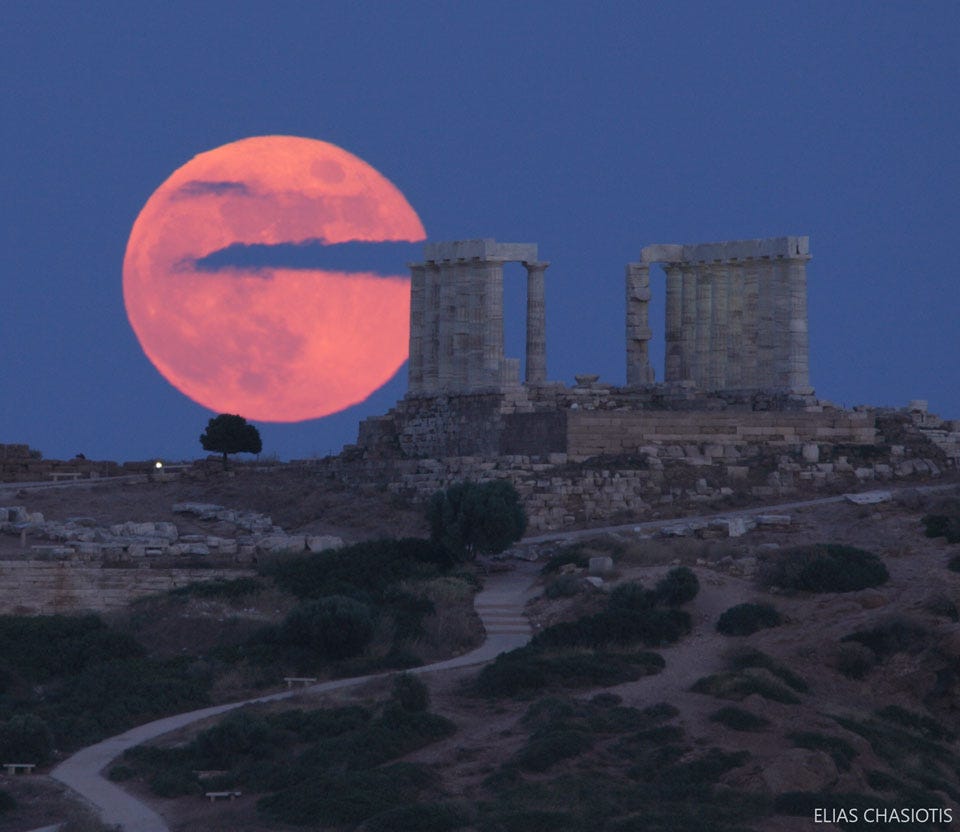
Fingers crossed you can enjoy a sweet ‘Strawberry’ Full Moon tonight, which will be the lowest in the sky since 2006 (or the highest if you’re in the southern hemisphere). This is due to the major lunar standstill, or lunistice, when the Moon reaches the most extreme point of its orbit around the Earth, which happens approximately every 18.6 years.
I explained this phenomenon before in my ‘Tilted’ newsletter, and I also discussed how the monthly full Moons were named in my ‘Moonstruck’ post.
The Strawberry Moon’s rosy glow is due to its proximity to the horizon. Its light must travel through a thicker layer of the Earth’s atmosphere, which scatters shorter wavelengths of blue light, thus giving the Moon a reddish tinge. It’s believed the name originated from the fact that is a good time to harvest wild strawberries in the northern hemisphere.
For those of you with access to Dark Skies (I also discussed this), the Strawberry Full Moon will appear near the centre of the Milky Way. NASA refers to the June - August period as ‘Core Season’ since the bright centre our home galaxy is most visible.
It’s also the best season to see noctilucent clouds, or ‘night-shining clouds’, the highest clouds found in Earth's atmosphere — I discussed this phenomenon in my ‘Night-Shining’ piece.
As someone with an amateur passion in astronomy, I dip in and out of this subject on a semi-regular basis. Since I’m approaching the two-and-a-half year mark of my reinvigorated newsletter, I have accrued a trove of posts, so now I must be careful not to repeat myself.
In my recent ‘Stuff and Ghosts’ newsletter I mentioned that the Japanese company ispace had launched a mission to the Moon in mid-January. Called Resilience, the lander was expected to touchdown in the Mare Frigoris region. Once on the Moon, it would then deploy the Tenacious rover, which contained several payloads, including the art installation ‘Moonhouse’.
Resilience successfully entered lunar orbit in May, and the mission was progressing smoothly until the final descent phase on 6 June.
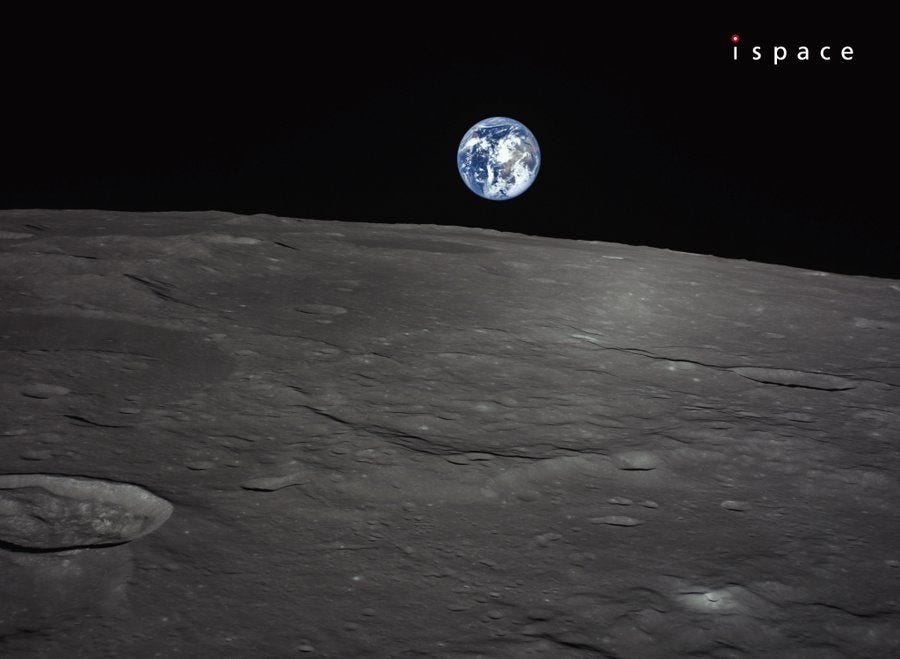
As Resilience decelerated, its laser rangefinder (responsible for measuring altitude), experienced delays acquiring valid readings. The craft couldn’t reduce its speed to execute a safe touchdown, and contact with the lander was severed moments before the landing.
Communication could not be re-established, and the mission was declared a bust. Sadly, this is ispace’s second consecutive unsuccessful lunar landing attempt, following the crash of the Hakuto-R Mission 1 in 2023. Yet, this is the process of science. Failure is part of the endeavour, no matter how disappointing. Each success is built upon the data of agonising defeats.
It made me wonder: what is the failure rate for missions to land craft on the Moon?
Based on a quick tally, there have been 17 lunar landing attempts (human and robotic, but not counting deliberate impactors1 or orbiters), with 12 successes and 5 failures.
This puts the failure rate for lunar missions at about 29.4%. Despite all our advances in technology, this remains a difficult achievement!
There are so many challenges to overcome, such as the lack of atmosphere (which doesn’t allow for parachutes and makes braking impossible so deceleration must be handled by rocket engines), the rugged and rocky terrain, the lack of local navigation guidance, the difficulty in piloting a landing, the extreme fluctuations in lighting and temperature, and the razor-thin fuel margins.
The smallest errors or systems malfunction can have catastrophic results. So when there is a successful landing, it’s no wonder the engineers and scientists leap with joy!
But what is the Moonhouse art installation? Conceived by Swedish artist Mikael Genberg about twenty-five years ago, the aim was to place a model of a familiar domestic symbol — a red Swedish house — on the moon.
By placing something as simple and down-to-earth as a red house in a place as remote, inhospitable and colourless as the moon, Mikael Genberg questions our perception of what is possible and meaningful in the cosmos. Moreover, The Moonhouse carries a poetic undertone. It reminds us of our roots and our home on Earth while symbolizing our dreams and ambitions to explore and expand beyond our known boundaries.
By choosing a small red house for his art project, Genberg forces the viewer to reflect on the scale of our ambitions and what is truly meaningful in our quest to conquer space. The Moonhouse thus becomes not only an artwork but also a symbol of humanity’s eternal pursuit of the unknown and unexplored.
The model was mounted on the Tenacious rover, which was programmed to find suitable real estate for the wee house and to set it down.
While I love the idea, and the symbolism of the project, there is something equally mythic about this human-centric illusion being wrecked upon the hard realities of an alien environment. It only takes lagging guidance lasers to smash our hubris.
There will be no ‘conquering space’ — if or when we move to other worlds, we will need to re-imagine our lives to match our circumstances, not attempt to burden our new existence with out-dated structures.
Luna will force us to meet her on her terms.
Impactors are craft designed for high-speed collision and destruction, with the objective being the study of their impact.
Fascinating as always Maura. The more I learn about space, the more I realise we have something very special here on Earth.